5 Types of Music Mastering Studio Operations to Consider in 2026
A common mistake when booking a music mastering studio is assuming that the processor chain matters more than the listening environment. Engineers often obsess over which brand of limiting amplifier a facility uses, entirely ignoring whether the room's acoustic geometry actually reveals sub-bass masking. A mastering room is not merely a collection of expensive hardware; it is an acoustic microscope designed to expose the flaws a mixing suite naturally hides. If the playback system cannot accurately render intersample peaks or phase incoherence in the low frequencies, no amount of boutique equalization will save the final print from sounding harsh on commercial streaming platforms.
Quick Summary
Choosing a professional mastering facility requires matching your project's technical needs to a specific operational framework, rather than shopping for prestige. Different formats, from high-fidelity physical media to rapid digital releases, demand entirely different processing environments.
- Hybrid analog facilities provide harmonic richness but require deliberate recall workflows.
- Vinyl specialists apply format-specific mechanical limits to prevent playback failures.
- Algorithmic platforms offer immediate loudness adjustments but ignore complex masking issues.
- Solo digital engineers provide rapid revisions but rely heavily on software emulation.
- Stem specialists allow granular control over instrument groups at the cost of the original mix balance.
Table of Contents
- Buying Guide: Choosing the Right Facility
- 1. Premium Hybrid Analog Facilities
- 2. Dedicated Vinyl Pressing Studios
- 3. Automated Algorithmic Platforms
- 4. Freelance In-the-Box Engineers
- 5. Stem Mastering Specialists
- Matching Your Project to an Operational Model
- FAQ
- Recommended Reads
| Product Category | Operational Model | Features | Pros | Cons | Target Audience |
|---|---|---|---|---|---|
| Premium Hybrid Analog Facilities | Hybrid Outboard | Physical outboard gear, dedicated A/D converters, precision monitoring | Harmonic richness, depth preservation, clipping prevention | Slower recall times, higher cost, requires finished mixes | Professional independent artists, record labels |
| Dedicated Vinyl Pressing Studios | Format-Specific Physical | RIAA curve application, bass mono-summing, mechanical de-essing | Flawless physical playback, prevents stylus jumping, side-sequencing | Unsuited for streaming loudness, expensive specialized labor | Vinyl record collectors, independent physical releases |
| Automated Algorithmic Platforms | Algorithmic Cloud | AI frequency matching, instant file rendering, metadata analysis | Immediate turnaround, extremely low cost, zero scheduling | Cannot fix complex masking, blind to creative intent, generic sound | Demo creators, rapid-release content creators |
| Freelance In-the-Box Engineers | Solo Digital | Plugin-based dynamics, digital metering, rapid bounce times | Quick revisions, affordable rates, high accessibility | Relies entirely on digital emulation, varying acoustic accuracy | Budget-conscious musicians, digital-only artists |
| Stem Mastering Specialists | Multi-Track Print | Sub-group bus processing, parallel vocal/drum control, targeted dynamics | Fixes lingering mix flaws, hyper-specific control, distinct clarity | Blurs the line with mixing, higher base cost, phasing risks | Producers struggling with mix balance, complex arrangements |
Buying Guide: Choosing the Right Facility
Evaluating audio mastering studios requires looking past the equipment list to understand how the business actually processes audio. The critical lens that separates these options is their Operational Model. This dictates where the audio physically travels, how the dynamics are controlled, and the speed at which revisions can be executed.
We categorize these facilities into five distinct models. Hybrid Outboard operations route digital audio through physical analog hardware before capturing it back into a computer, prioritizing harmonic depth over instant revisions. Format-Specific Physical operations manipulate audio strictly to survive the mechanical limitations of a physical format like a vinyl lathe. Algorithmic Cloud solutions remove human engineers entirely, using spectral analysis software to match your track to a generic loudness curve. Solo Digital workflows exist entirely within computer software, utilizing emulations of physical gear to work rapidly. Finally, Multi-Track Print operations require producers to export their tracks as separate groups, essentially performing a combination of mixing and final equalization.
Understanding these operational models prevents you from paying an analog rate for a digital problem, or trusting a mechanical process to a cloud algorithm.
1. Premium Hybrid Analog Facilities
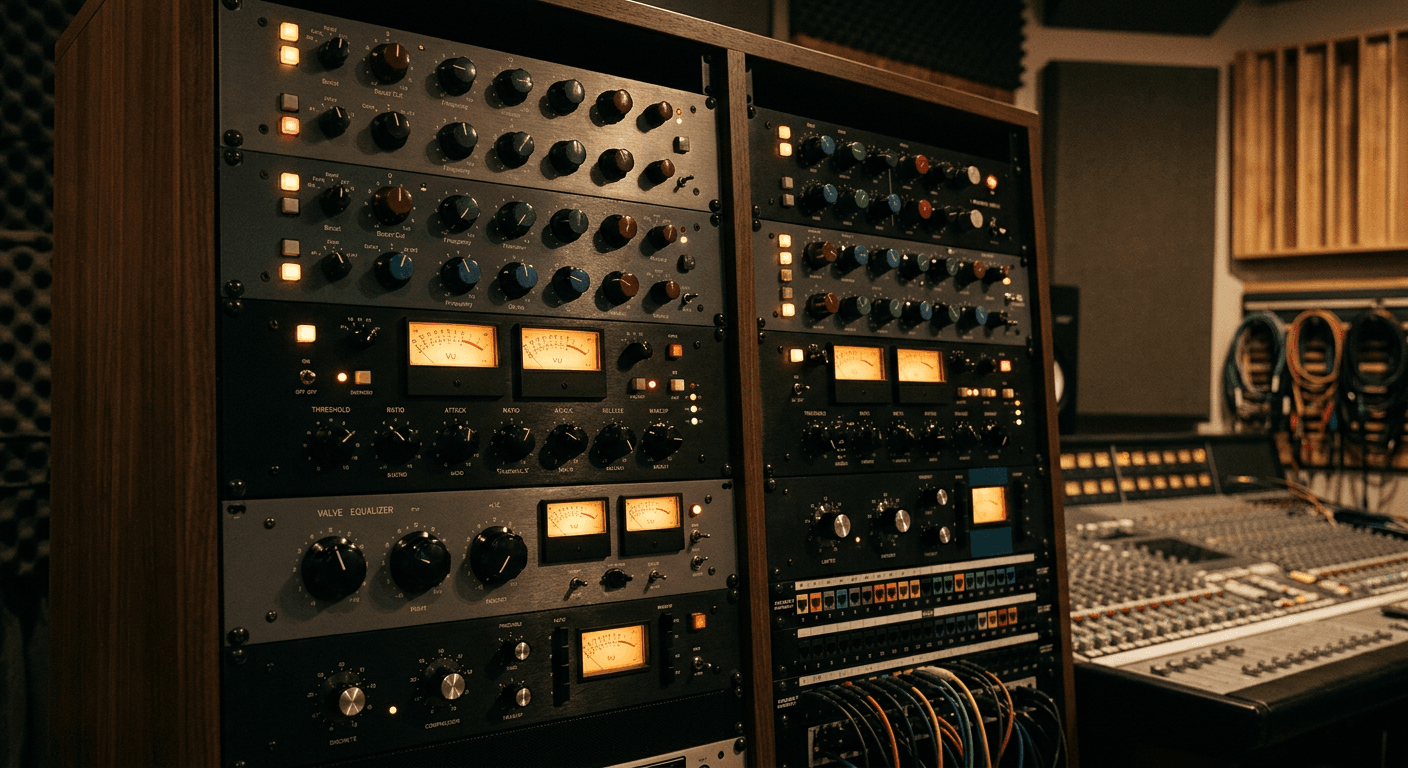
A mastering engineer threading a physical patch bay to route a digital stereo track through a high-voltage vacuum tube equalizer is the defining image of this tier. This model is built for artists requiring dense, commercially competitive releases that retain dynamic impact without sounding brittle. It operates by converting the incoming digital file into an analog voltage, driving that signal through dedicated outboard compressors and equalizers to impart subtle harmonic distortion, and then printing the result back into the digital realm through an mastering-grade analog-to-digital converter. The conversion stage itself acts as a transient tamer, naturally clipping microscopic audio peaks before a digital limiter ever touches the file.
Physical Headroom Forgives Digital Harshness
Because the audio is literally leaving the computer as electrical current, it benefits from the physical headroom of heavy transformers and tubes. This prevents the harsh, fatiguing high frequencies often associated with purely digital limiting algorithms. When evaluating mastering and mixing services, the physical equipment involved directly influences the final depth of the soundstage.
The structural boundary of a physical outboard workflow is recall agility. If a client requests a half-decibel reduction in the upper midrange three days after the session, the engineer must manually reset the physical dials on multiple pieces of hardware to match the exact state of the original session. This makes iterative micro-revisions highly inefficient, and clients must ensure their mix is absolutely final before booking the time. I would hold off on a hybrid analog session if a project involves daily arrangement changes, as the constant recalibration disrupts the studio's schedule and incurs heavy revision fees.
Secure this facility type when a finalized mix requires the physical weight and spatial depth that software emulation struggles to replicate.
Pros
- Imparts natural harmonic distortion that binds a mix together.
- Prevents digital clipping fatigue through physical voltage headroom.
- Utilizes pristine conversion to widen the stereo image.
Cons
- Manual hardware recalls slow down the revision process.
- Requires higher upfront capital than digital-only services.
- Exposes fundamental mix flaws rather than masking them.
2. Dedicated Vinyl Pressing Studios
Cutting a lacquer master requires strict phase coherence in the low frequencies, removing the luxury of wide, stereo sub-bass. This service targets independent musicians and labels manufacturing physical records, where the mastering process is less about creative enhancement and entirely focused on mechanical survival. The engineer applies a specific RIAA equalization curve to the audio, heavily attenuating the low frequencies and boosting the highs. During playback, the listener's turntable reverses this exact curve.
Mechanical Limitations Dictate the Processing Ceiling
The mechanism here is primarily preventative. If high-frequency vocal sibilance is left unchecked, the cutting stylus will accelerate too quickly, causing the consumer's needle to literally jump out of the groove. Similarly, out-of-phase bass frequencies force the cutting head to make impossible vertical movements. The engineer must fold all sub-bass information to a mono signal, aggressively de-ess the cymbals and vocals, and manually sequence the tracklist to ensure loud, dynamic songs are placed on the outer edge of the disc where mechanical fidelity is highest.
Practical rule: Never send a master optimized for digital streaming directly to a pressing plant; the extreme limiting and widened low-end will physically compromise the lacquer cut.
The inherent limitation of this discipline is its incompatibility with modern digital standards. A master cut safely for a turntable will sound noticeably quieter, narrower, and less aggressive if uploaded directly to a digital streaming service without a secondary, separate mastering pass. What would make me hesitate to hire a vinyl specialist is if the artist only plans to release music online, as the mechanical safeguards actively hinder digital loudness.
Opt for this discipline exclusively to guarantee a flawless transfer from digital files to a physical, grooved format.
Pros
- Ensures physical records play without skipping or distortion.
- Maintains the necessary dynamic range required by mechanical styli.
- Provides professional track sequencing based on physical disc space.
Cons
- Produces files unsuitable for competitive digital streaming volumes.
- Requires a separate digital master to cover all release bases.
- Involves specialized labor that significantly increases project costs.
3. Automated Algorithmic Platforms
A producer finishing a demo at 3 AM needs an instant loudness boost for a morning meeting, bypassing human scheduling entirely. This service is aimed directly at high-volume content creators, hobbyists, and artists needing rapid reference tracks. The platform works by analyzing the frequency spectrum of your uploaded file, comparing its dynamic range and tonal balance against a vast database of commercially released music in a matching genre. It then applies complex, multi-band digital equalization and aggressive limiting to force the audio file to mimic the target reference curve.
Processing Speed Replaces Critical Human Judgment
The software applies phase-linear EQ adjustments and dynamic compression in seconds, rendering a loud, competitive file without routing the audio through any physical circuits. It reacts exclusively to mathematical peak values and average loudness algorithms, automatically adjusting the threshold of its limiters to hit a target LUFS (Loudness Units relative to Full Scale) without user intervention.
The critical failing of this system is its blindness to creative context and frequency masking. If an algorithmic platform detects a buildup of low-midrange frequencies, it will dutifully cut them to match its target curve. It does not know if that frequency buildup is unwanted acoustic mud, or the fundamental resonance of a deliberately dark cello solo. I skip algorithmic platforms entirely when working with complex acoustic instruments where subtle harmonic interplay defines the record's identity, as the software will relentlessly flatten the dynamics to meet a generic quota.
Utilize this service strictly when immediate loudness is required for a demo or uncritical listening environment.
Pros
- Delivers finalized audio files in a matter of seconds.
- Operates at a fraction of the cost of a human engineer.
- Requires zero scheduling, available continuously via the cloud.
Cons
- Fails to recognize artistic intent behind unorthodox mix balances.
- Cannot correct phase alignment or complex instrument masking.
- Often applies heavy-handed limiting that fatigues the listener.
4. Freelance In-the-Box Engineers
"Can I get commercial loudness without paying for studio overhead?" This model serves independent artists seeking professional oversight on a tight budget. The workflow relies strictly on digital software plugins rather than outboard hardware. The engineer loads the audio into a digital audio workstation and chains together emulations of analog equalizers, digital clippers, and true-peak limiters. Because the audio never leaves the computer environment, the processing is entirely math-based, allowing the engineer to save exact states and toggle between wildly different processing chains instantaneously.
Emulation Precision Relies on Acoustic Honesty
This approach shines in its administrative efficiency. When connecting with an online mastering studio worldwide, clients expect rapid file delivery. A digital operator can export a revision, address a client note, and re-export the file in minutes without writing down a single hardware parameter. They use high-resolution digital metering to precisely control intersample peaks, ensuring the file translates perfectly to lossy streaming codecs without triggering digital distortion.
The danger of this approach lies in the monitoring environment. A freelancer relying solely on software plugins must have a flawlessly treated acoustic space. If their room has a null point at 60Hz, they will unknowingly boost the bass in the software to compensate, ruining the track for anyone listening in a balanced environment. I would prioritize this route only when rapid, iterative revisions are necessary and the engineer's listening environment is verifiably transparent.
Hire a purely digital operator provided your release schedule demands rapid adjustments and precise digital limiting.
Pros
- Facilitates lightning-fast, highly accurate session recalls.
- Keeps hourly rates lower by avoiding physical equipment maintenance.
- Allows surgical removal of harsh digital artifacts using dynamic EQ.
Cons
- Lacks the physical transformer saturation of analog chains.
- Vulnerable to poor translation if the engineer's room is untreated.
- Can lead to over-processing due to limitless plugin availability.
5. Stem Mastering Specialists
Rather than presenting a single stereo file, producers provide the engineer with four to eight distinct audio subgroups, such as separated drums, vocals, bass, and synthesizers. This targets projects suffering from fundamental balance issues that a standard stereo processor cannot cleanly resolve. The engineer sums these buses together through an analog console or digital summing mixer, applying independent dynamic control to the vocal track without accidentally clamping down on the snare drum.
Granular Separation Risks Undoing the Mix
This mechanism allows for extreme rescue operations. If the kick drum is severely lacking punch, the engineer can aggressively equalize the drum stem to restore transients without altering the low-end of the bass guitar. When evaluating stem mastering services, the primary advantage is this uncompromised isolation. The engineer prints a final stereo track only after all stems have been dynamically balanced against each other in the mastering room.
Practical rule: Never apply heavy bus compression to your stems before exporting them; printing compression limits the specialist's ability to manipulate the dynamics later.
The inherent trade-off is the loss of the original mix cohesion. It heavily blurs the line between mixing and mastering, shifting creative balance decisions to the final stage of production. When you alter the volume or equalization of a vocal stem independently, the phase relationship between the vocal and the instrumental bed shifts, potentially ungluing a mix that felt cohesive in the studio. My hesitation with stem grouping arises when producers use it as a crutch to avoid committing to a final mix balance, dramatically inflating the studio bill.
Invest in multi-track processing only when insurmountable mix flaws prevent a standard stereo file from competing commercially.
Pros
- Allows surgical dynamic control over isolated instrument groups.
- Corrects severe mix imbalances without artifacts.
- Provides the engineer with maximum flexibility for targeted limiting.
Cons
- Easily alters the producer's intended emotional mix balance.
- Introduces phase incoherence if stems are processed carelessly.
- Costs significantly more due to the extended setup and routing time.
Matching Your Project to an Operational Model
Navigating the options requires mapping your specific audio constraints to the right classification.
If your primary requirement is retaining depth while achieving commercial loudness, the Hybrid Outboard model offers the best balance of physical transformer weight and digital precision.
If you are manufacturing physical records and need to ensure your audio survives the lathe, you must utilize a Format-Specific Physical operation to mechanically safeguard the lacquer cut.
If you are restricted by extreme budget constraints and require an instant loudness boost for a non-commercial demo, the Algorithmic Cloud model removes human overhead entirely.
If your release relies on rapid digital distribution and you anticipate requiring multiple, fast revisions based on label feedback, the Solo Digital model ensures exact recall agility without setup delays.
If your project suffers from a buried vocal or overbearing low end that cannot be isolated in a single stereo file, the Multi-Track Print model provides the isolation necessary to rescue the balance.
FAQ
What makes a sound mastering studio different from a recording facility? A mastering facility is acoustically designed for critical listening and precise playback translation, whereas a recording facility is built to capture raw acoustic performances. The mastering room focuses entirely on frequency balance, dynamic range control, and final formatting.
Do audio mastering studios require me to attend the session? No. Most professional facilities operate highly efficient remote workflows. You upload high-resolution digital files, and the engineer processes the audio in their controlled environment, returning the finalized tracks for your approval via secure digital delivery.
Why do analog mastering services cost more than algorithmic platforms? Analog services factor in the maintenance of physical outboard hardware, premium analog-to-digital converters, and the time required for a human engineer to critically evaluate and physically route the audio. Algorithms bypass physical gear and human listening entirely.
Can mastering fix a distorted mix? Mastering cannot remove baked-in distortion or restore audio data that was destroyed by aggressive digital clipping during the mix phase. A sound mastering studio can only enhance, balance, and limit what is provided in the source file.