6 Mixing Mastering Course Structures for Audio Engineers in 2026
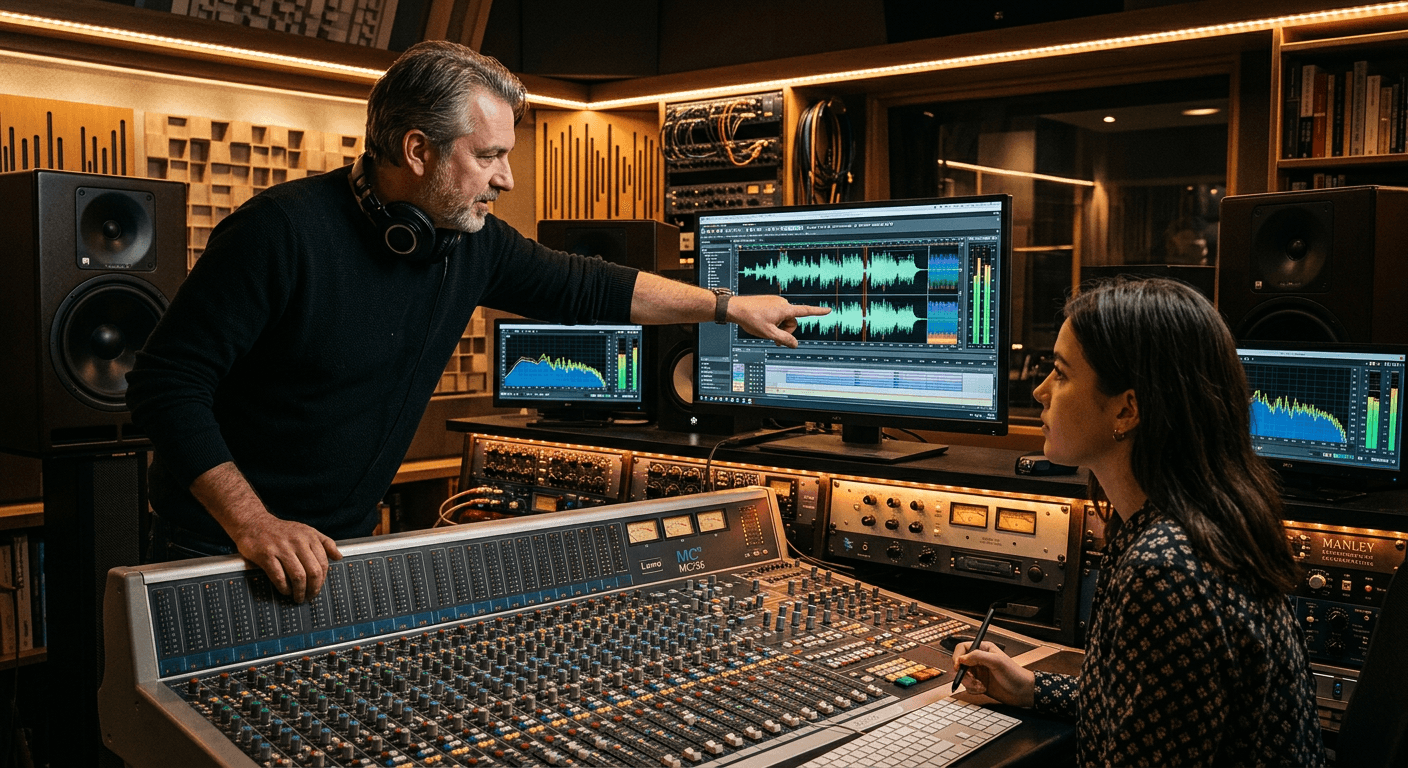
A young engineer stacks five digital compressors on a vocal bus, yet the track still falls apart the moment it is played on a car stereo. They assume the software is the problem or that they need an expensive analog emulation, but the real bottleneck is the ear and the listening environment. Finding the right mixing mastering course in 2026 means moving past scattered tutorial videos that merely show you what knobs someone else turned. You need a curriculum that teaches you the physics of sound, how to measure room acoustics, and exactly why an equalizer behaves the way it does before you ever touch a fader.
Quick Summary
A mixing mastering course is a structured educational program designed to teach the acoustic principles, signal flow, and critical listening skills required to balance and finalize audio recordings. Selecting the right format depends heavily on whether you need foundational theory, real-time feedback, or advanced genre-specific workflow techniques.
- Degree programs offer deep acoustic theory but lag behind modern software speeds.
- Mentor-led cohorts provide the essential feedback loop missing from solo learning.
- Masterclass libraries are built for workflow observation, not technique correction.
- Apprenticeships bridge the gap between digital convenience and analog reality.
Table of Contents
- How to Evaluate a Mixing Mastering Course
- 1. University-Level Degree Programs
- 2. Online Mentor-Led Cohort Bootcamps
- 3. Subscription-Based Pro Masterclass Libraries
- 4. Self-Paced Technical Modules
- 5. One-on-One Studio Apprenticeships
- 6. Specialized Format Intensives
- Where the Training Breaks Down
- FAQ
- Recommended Reads
How to Evaluate a Mixing Mastering Course
The modern audio engineering landscape is flooded with curriculum options, making it difficult to separate genuine education from simple entertainment. When evaluating any mixing mastering course, you must judge it across two specific criteria: feedback latency and signal flow fundamentals.
Feedback latency is the speed at which an instructor can hear your mistake and correct your process. If a course format cannot tell you that your 250Hz cut ruined the snare drum, it is passive observation, not active learning. Signal flow fundamentals dictate whether the program teaches you how to build a processing chain from scratch based on the raw audio in front of you, or if it simply hands you a preset template to copy. A program that only teaches plugin presets will leave you completely lost the moment a client hands you a poorly recorded track that does not fit the template. Judge every option on this list by how well it forces you to train your ears rather than just memorizing software interfaces.
| Course Format | Best Audience | Core Mechanism | Primary Limitation |
|---|---|---|---|
| Degree Programs | Aspiring acousticians | Mathematical acoustic physics | Slow adaptation to software |
| Cohort Bootcamps | Intermediate producers | Peer-reviewed A/B testing | Locked weekly pacing |
| Masterclass Libraries | Working professionals | Over-the-shoulder observation | Zero personalized feedback |
| Technical Modules | Absolute beginners | Parameter-level screen capture | Lacks musical context |
| Apprenticeships | Commercial facility operators | Real-world client shadowing | Highly dependent on mentor |
| Format Intensives | Service-expanding engineers | Strict delivery parameters | Requires flawless foundations |
1. University-Level Degree Programs
University programs are multi-year institutional commitments designed for students who want a comprehensive understanding of acoustic physics, electrical engineering, and historical context alongside their practical mixing education.
The curriculum is built on the mathematics of sound waves, studio design, and electrical basics. Long before touching a digital equalizer, students measure room modes using testing microphones and calculate standing waves. They learn to trace an audio signal from a microphone capsule, through a complex patch bay, into the physical mastering equipment and back out to the monitors. Because the focus is foundational, the mechanical operation of mastering equipment is taught at the component level, ensuring students understand what analog saturation physically is rather than just what it sounds like.
Extensive theory, detached from modern turnaround times
This route is painfully slow and exceptionally expensive. The curriculum is often locked into a rigid institutional accreditation cycle, meaning it severely lags behind current industry software updates. If you need to learn how to deliver a commercially competitive, loudness-normalized master for a streaming platform next month, a university program will spend your first semester teaching you the history of magnetic tape instead.
Check the syllabus for the ratio of acoustic physics to modern digital workflow. If the program spends less than a third of its time on in-the-box techniques, it is preparing you for a studio environment that barely exists anymore. It suits those building a 40-year foundation in audio science, but it completely fails the independent producer looking to fix immediate low-end translation issues.
2. Online Mentor-Led Cohort Bootcamps
Mentor-led cohorts are intensive, schedule-bound remote classes running typically for 8 to 12 weeks. They are ideal for intermediate producers who have hit a plateau and cannot figure out why their mixes lack depth.
Students download a standardized set of raw multitracks, balance them during the week, and submit the session files. The instructor opens the digital audio workstation on a live stream, isolates the student's drum bus, and physically demonstrates how a 400Hz buildup is masking the bass guitar. This real-time A/B comparison forces the student to hear their own blind spots. Because the entire feedback loop happens digitally across different time zones, students routinely collaborate with an online mastering studio worldwide, heavily simulating the reality of modern remote audio delivery and client communication.
Accelerated critical listening constrained by rigid pacing
The rigid pacing of a cohort leaves absolutely no room for hesitation or life interruptions. If a student struggles to understand mid-side equalization during week three, the cohort still moves on to dynamic range compression in week four. You cannot pause the syllabus to catch up, and if you miss a submission window, you lose the feedback for that week entirely.
Practical rule: Always verify the student-to-mentor ratio before enrolling in a cohort. Once a class exceeds 15 students, personalized feedback inevitably devolves into generic advice, meaning you are paying a premium for a standardized checklist rather than tailored instruction.
3. Subscription-Based Pro Masterclass Libraries
Subscription libraries offer massive catalogs of pre-recorded, over-the-shoulder video documentation featuring veteran engineers working on commercial releases. They are built for advanced engineers seeking workflow inspiration and niche, genre-specific processing philosophies.
You watch the instructor route complex parallel compression chains, dial in exact attack and release times on bus limiters, and explain their psychological approach to handling client revisions. The mechanism is pure visual and auditory observation - you see exactly how they gain-stage a heavy metal track versus an acoustic ballad, and you can pause to copy their plugin parameters exactly as they are set on the screen.
High inspiration with zero course correction
This format provides zero course correction. It is pure observation, which presents a massive danger to novice engineers. When an expert applies a harsh 4kHz boost to a world-class vocal recorded through a pristine vintage microphone, it works for that specific, high-fidelity recording.
Do not blindly apply that exact same EQ curve. You will completely destroy the mix. This happens with a harsh, poorly recorded vocal in an untreated bedroom. These libraries teach the choices made for a perfect scenario. They do not hear your mix. They cannot tell you that your room acoustics are hiding a massive frequency null at 80Hz. Mute the video. Try to predict the engineer's EQ moves based on what you hear. If you cannot, you do not have the foundational skills required to benefit from this format.
4. Self-Paced Technical Modules
Self-paced modules are individual, buy-once video courses focusing exclusively on dissecting one distinct technical skill set, such as digital limiting, vocal tuning, or phase alignment. They are meant for beginners needing immediate, specific software answers.
The instructor utilizes screen captures of high-resolution spectrum analyzers to visually prove what an audio processor is doing to a waveform. For example, a module on low-end management will graphically show the phase cancellation that occurs when a kick drum and bass guitar compete for the same sub-frequencies. Supplementing these specific video lessons with written mastering guides ensures that the student grasps the mathematical reality of digital audio processing before they start turning knobs aimlessly.
Excellent software manuals absent of musical context
These courses teach the tool, but they cannot teach taste. You will learn exactly how to configure a dynamic EQ to duck a specific frequency band, but the course will not tell you when a track actually requires it. They are essentially excellent software manuals divorced from any real musical context.
If you already know how every parameter on a multiband compressor functions but your mixes still sound lifeless, buying another technical module will not solve your problem. You must apply the specific technique immediately to your own session before watching the next module; otherwise, the information remains purely theoretical and does nothing to improve your final audio bounce.
5. One-on-One Studio Apprenticeships
Apprenticeships are direct mentoring arrangements where a developing engineer physically or virtually shadows a veteran facility operator. This route is strictly for those aiming to manage commercial records and high-paying clients.
Direct shadowing places a learner inside the daily workflow of a commercial facility. Observing a seasoned professional - much like a Grammy-winning mastering engineer - reveals the undocumented reality of the job. The apprentice handles file quality control, builds session recall sheets, and maintains physical hardware. They learn how hard they can push an analog-to-digital converter before it clips unpleasantly, and they observe how to gently tell a client that their mix needs to be recalled due to a phase issue. The actual education happens in the gaps between technical tasks.
Real-world pressure testing reliant on mentor communication
The barrier to entry is immense, and the educational quality is entirely unpredictable. A brilliant engineer is not automatically a competent teacher.
If the mentor refuses to explain their decision-making process, you are not an apprentice; you are simply an unpaid studio assistant fetching coffee and sweeping floors. Ask the mentor upfront if you will be allowed to handle minor client revisions or perform A/B quality checks on active sessions. This route completely fails if the mentor views you as cheap labor rather than a developing peer who needs hands-on time with the console.
6. Specialized Format Intensives
Specialized intensives are short, highly focused workshops dedicated exclusively to complex delivery formats, such as spatial audio or preparing physical mediums. They are aimed at working mix engineers looking to expand their commercial service offerings.
These courses dive strictly into the physical and digital limitations of a specific medium. Preparing audio for physical mediums requires rigid technical parameters, similar to the precision needed for professional vinyl mastering services. Engineers learn why aggressive de-essing and strict mono bass fold-down are non-negotiable to prevent a physical stylus from jumping out of a record groove during playback.
Similarly, learning to prepare audio for stem mastering services requires understanding how to balance grouped instrument buses so that the final engineer has maximum dynamic flexibility without destroying the original mix balance.
Vital for format translation but useless for foundational balance
Specialized intensives assume you already possess a flawless understanding of static balancing, equalization, and compression. They do not teach basics.
If you cannot produce a commercially competitive stereo mix in the digital realm, learning the RIAA equalization curve for a physical record will not help you in any capacity. Always compare your intensive output against commercial standards using a specialized metering plugin before assuming the newly learned technique worked. They are finishing schools for specific formats, entirely useless for someone still struggling with basic vocal gain staging.
Where the Training Breaks Down
Choosing the wrong course structure will cost you months of wasted effort. If your bottleneck is basic software operation, take a self-paced technical module. If your bottleneck is translation - meaning your track sounds massive in the studio but falls apart in the car - you need the immediate, painful critique of an online mentor-led cohort.
If you already have the speed and the ear but lack the final 5% of commercial polish, watch a masterclass library to observe professional workflows. Avoid university degree programs unless you are pursuing formal acoustic design or electrical engineering, and seek an apprenticeship only when you are ready to transition from a solo hobbyist to a commercial facility operator managing demanding clients.
FAQ
Does a mixing mastering course require expensive analog gear?
No. Most modern educational programs focus heavily on digital workflows and "in-the-box" processing. While understanding analog gain staging is crucial, the foundational principles of EQ, compression, and phase alignment can be learned entirely with stock plugins.
How long does it take to learn audio engineering through an online cohort?
Most mentor-led bootcamps run between 8 to 12 weeks. However, developing the critical listening skills required to consistently apply what you learned takes most engineers an additional one to two years of daily practice.
Can self-paced modules replace a university degree in acoustics?
Self-paced modules are excellent for learning software operation and specific mixing techniques, but they do not cover the advanced mathematics, electronics, and physical room design theory that a university-level acoustics program provides.
What is the main difference between watching a masterclass and taking a cohort bootcamp?
A masterclass offers observation without feedback; you watch a professional work on their own files. A cohort bootcamp provides a feedback loop where an instructor directly critiques your specific mix and points out your unique blind spots.