Choosing Studio Monitors for Mixing: 6 Monitoring Categories Compared
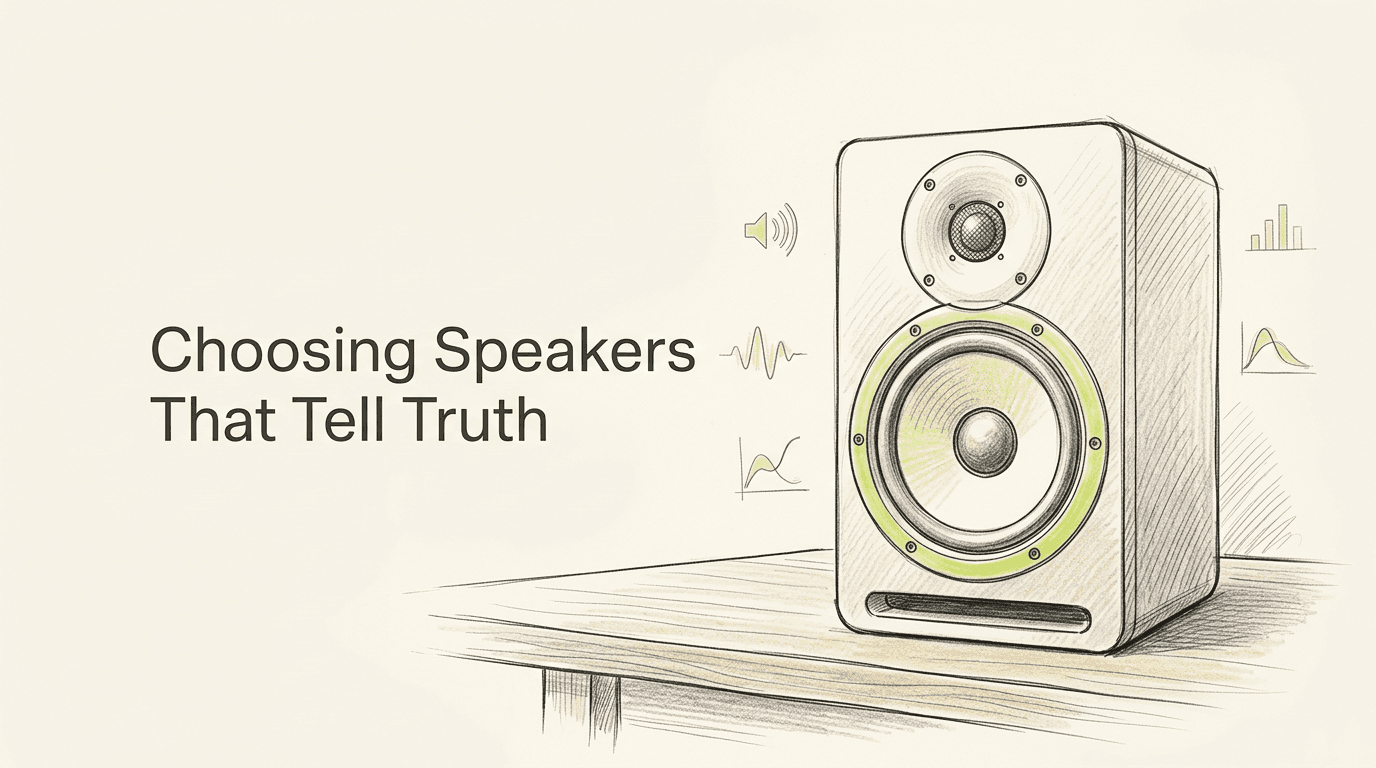
A mix sounds flawless at the console, but the moment it plays in a car, the low-end disappears and the vocal is suddenly buried. This happens because the monitoring system lied. It presented a localized, artificially enhanced version of the audio rather than the flat acoustic reality. Choosing the right studio monitors for mixing is about understanding exactly how a specific speaker architecture interacts with the air in the room, and identifying which frequencies it structurally ignores.
Quick Summary
Professional monitoring systems are acoustic tools designed to expose flaws in a mix rather than make the music sound pleasant. They rely on flat frequency responses and specific driver architectures to translate audio accurately across consumer playback systems.
- Nearfield setups minimize room interference by prioritizing direct sound.
- Midfield configurations separate the midrange to prevent crossover distortion.
- Wearable monitoring isolates the listener for surgical transient extraction.
- Single-driver formats intentionally roll off extremes to test structural balance.
Table of Contents
- Why studio monitors for mixing dictate your decisions
- The acoustic reality check: How to choose
- 1. 2-Way Nearfield Monitors
- 2. 3-Way Midfield Monitors
- 3. Full-Range Mastering Towers
- 4. Open-Back Planar Magnetic Headphones
- 5. Closed-Back Dynamic Headphones
- 6. Single-Driver Mix Cubes
- Matching the monitoring format to the failure point
- FAQ
- Recommended Reads
Why studio monitors for mixing dictate your decisions
The physical dimension of a speaker cone dictates how much air it can move, which directly governs the lowest frequency it can accurately reproduce. When evaluating studio monitors for mixing, engineers must separate the marketing claims of deep bass from the physical realities of acoustics. A small driver housed in a small cabinet will inherently roll off the sub-harmonics unless it utilizes a tuned port, which inevitably introduces resonance and smears the timing of the low end. Every decision made at the console is a reaction to what the monitors project. If the system artificially tightens the bass, the resulting professional mixing workflows will overcompensate, creating a master that sounds muddy and loose everywhere else.
| Category | Primary Monitoring Role | Features | Pros | Cons | Target Audience |
|---|---|---|---|---|---|
| 2-Way Nearfield Monitors | Surgical Balance | 5"-7" woofers, integrated crossovers, near-proximity placement | Excellent midrange clarity, minimizes room reflections, highly cost-effective | Severe sub-bass roll-off, port resonance issues, narrow sweet spot | Independent artists and bedroom producers |
| 3-Way Midfield Monitors | Full-Spectrum Mastering | Dedicated midrange driver, higher SPL output, wider dispersion | Zero vocal crossover smearing, high headroom, wider sweet spot | Requires extensive acoustic treatment, higher cost, comb filtering risks | Professional engineers and mid-sized studios |
| Full-Range Mastering Towers | Full-Spectrum Mastering | Unported sealed cabinets, massive multi-driver arrays, floor-standing | Absolute frequency linearity, zero port resonance, true sub-harmonic reveal | Demands architectural acoustic design, massive footprint, extreme expense | Dedicated mastering facilities |
| Open-Back Planar Magnetic Headphones | Micro-Detail Extraction | Ultra-thin magnetic diaphragms, vented earcups, zero cabinet resonance | Flawless transient speed, zero acoustic comb filtering, lightweight | Zero recording isolation, lacks physical bass impact, fragile diaphragms | Mixing engineers executing final detail passes |
| Closed-Back Dynamic Headphones | Translation Checking | Sealed acoustic chambers, dynamic voice coils, high clamping force | Total tracking isolation, prevents microphone bleed, highly durable | Exaggerated bass pressure, severe ear fatigue, compromised stereo width | Tracking engineers and vocalists |
| Single-Driver Mix Cubes | Translation Checking | Single paper cone, zero crossover network, restricted frequency range | Brutally honest midrange, zero phase shift, mimics consumer devices | Aggressively harsh tone, zero sub-bass, zero high-end air | Professionals checking cross-platform translation |
The acoustic reality check: How to choose
Evaluating these tools requires looking at them through a specific lens: the Primary Monitoring Role. This axis dictates what job the tool actually performs during a session, separating formats by their acoustic function rather than their price tag.
- Surgical Balance: Systems built to sit close to the listener, minimizing room reflections so the engineer can focus entirely on leveling the core elements of the track.
- Full-Spectrum Mastering: High-output configurations designed to push massive amounts of air, revealing the absolute lowest and highest extremes of the frequency spectrum.
- Micro-Detail Extraction: Wearable systems that remove the room entirely, operating with extreme driver speed to expose clicks, pops, and reverb tails.
- Translation Checking: Restricted or isolated formats used exclusively to verify how the audio will behave in compromised consumer environments or during tracking.
1. 2-Way Nearfield Monitors
Teams often install these expecting massive low-end impact, only to push the woofers into distortion trying to feel the bass. They are compact, two-driver systems engineered specifically for close-proximity listening in treated or partially treated rooms. Because their architecture targets Surgical Balance, you should never compare them against club PA systems or floor-standing systems. They are precision tools for the center of the mix.

The mechanism relies entirely on physical proximity to outrun the room's acoustics. An active crossover network splits the incoming audio signal. High frequencies route to a dedicated tweeter, and low-to-mid frequencies reach a single woofer. By positioning the listener strictly within one to one-and-a-half meters of the drivers, the engineer ensures the direct sound hits their ears first. Side wall reflections bounce back milliseconds later. This high ratio of direct-to-reflected sound mathematically minimizes the room's acoustic influence, allowing precise leveling of lead vocals and snare drums without building a million-dollar facility.
Proximity masks acoustic reflections but limits sub-bass
Physics firmly restricts a five-inch or six-inch cone from accurately reproducing 30Hz without extreme mechanical assistance. To compensate for small drivers, manufacturers often use ported cabinets that artificially inflate the bass. This resonance creates a smeared, slow low-end response that hides true phase relationships. Attempting to execute surgical sub-bass cuts on these usually results in a muddy, blown-out master when played on a larger system. We would hold off on relying solely on this format if the project relies heavily on electronic sub-harmonics. They simply stop producing usable, accurate information below 50Hz.
Invest in this category when vocal leveling and midrange balance matter more than club-shaking sub frequencies.
Pros
- Minimizes the impact of poor room acoustics through near placement.
- Delivers exceptional clarity for leveling vocals and lead instruments.
- Consumes very little physical space on a studio desk.
Cons
- Fails to reproduce accurate sub-bass frequencies below 50Hz.
- Bass ports introduce artificial resonance and time-smearing.
- Requires the engineer to sit locked in a very narrow sweet spot.
2. 3-Way Midfield Monitors
Unlike the close-proximity constraints of smaller setups, these systems are built to sit further back and push higher sound pressure levels across a much broader physical space. They are larger, three-driver configurations designed for commercial environments. Positioned firmly within the Full-Spectrum Mastering category, they should never be evaluated against small desktop speakers designed for bedroom producers.
By introducing a dedicated midrange driver, the internal crossover points shift away from the critical vocal frequencies. In a two-way system, the woofer struggles to reproduce a heavy kick drum and a lead vocal simultaneously, leading to intermodulation distortion. Here, the woofer is freed to focus exclusively on the low end. The midrange driver handles the vital 500Hz to 3kHz band seamlessly. Because they sit further away from the console, the acoustic waves have physical space to develop fully before reaching the engineer's ears. This is crucial for commercial audio mastering workflows where the relationship between the bass guitar and the kick drum must be absolutely defined.
Practical rule: Never place midfield systems directly against a front wall; they require at least three feet of clearance to prevent massive low-frequency boundary interference.
Midrange separation prevents crossover smearing
Pushing significantly more acoustic energy from further away means the physical room dictates exactly what you hear. Putting midfields in an untreated, small, square room guarantees severe comb filtering and aggressive low-end buildup. The massive bass energy will hit the rear wall and bounce back, cancelling out the direct sound from the speaker and creating dead zones where the bass simply vanishes. We would avoid specifying these for any facility that has not invested heavily in broadband acoustic absorption and dedicated bass trapping.
Upgrade to this format only when the acoustic treatment can physically absorb the immense low-frequency energy they project.
Pros
- Keeps vocal frequencies isolated from heavy low-end driver movement.
- Projects a much wider listening area for multiple clients in the room.
- Handles extremely loud transient peaks without entering distortion.
Cons
- Exposes every single acoustic flaw in an untreated room.
- Requires heavy, reinforced stands to prevent structural resonance.
- Increases the risk of hearing fatigue if monitored too loudly.
3. Full-Range Mastering Towers
An engineer pushes the playback volume, and the physical impact of the kick drum hits the chest without smearing the delicate vocal reverb. Floor-standing, multi-driver acoustic systems are engineered for absolute full-spectrum linearity. Engineers seeking Full-Spectrum Mastering rely on these massive units, which are never compared to standard mixing speakers. Purpose-built audio mastering monitors eliminate tuned ports entirely, relying on sheer cabinet volume to control the lowest frequencies.

Massive cabinet volume and multiple large drivers move enough air to flatly reproduce 20Hz to 20kHz natively. Instead of using a hole in the box to artificially sustain a bass note, sealed cabinet designs ensure that when the audio signal stops, the speaker cone stops instantly. This provides a lightning-fast transient response in the sub-bass region. They reveal the entire audible spectrum perfectly in phase, allowing the engineer to hear exactly how the lowest sub-harmonics interact with the upper harmonics of the kick drum. When designing an analog mastering facility, this uncompromised physical air movement is the foundation of the room's entire layout.
Absolute acoustic truth requires architectural commitment
The sheer size, extreme weight, and immense acoustic output demand a meticulously designed room. What would make us hesitate is installing these anywhere other than a heavily trapped, architecturally decoupled space. If you drop mastering towers into a standard commercial office space, they will simply expose the room's rattling drywall and chaotic flutter echoes rather than the details of the mix. They are ruthless, punishing speakers that make poorly mixed records sound terrible.
Reserve this massive investment for dedicated commercial facilities where uncovering the smallest sub-harmonic flaw is a daily operational requirement.
Pros
- Provides complete frequency linearity without artificial port tuning.
- Stops driver movement instantly for perfect low-end transient timing.
- Exposes microscopic phase issues across the entire audible spectrum.
Cons
- Demands expensive, professionally designed architectural acoustics.
- Occupies a massive physical footprint in the facility.
- Makes badly mixed client reference tracks sound incredibly harsh.
4. Open-Back Planar Magnetic Headphones
A missed click track bleed on a final vocal take is usually the event that sends engineers looking for this specific solution. These are reference-grade wearable monitors that let air pass freely through the earcups while delivering immense transient detail. Because Micro-Detail Extraction requires an unimpeded acoustic path, they should never be evaluated against standard tracking headphones designed for isolation.
A massive, ultra-thin diaphragm suspended evenly between magnetic arrays moves uniformly across its entire surface. This completely eliminates the chaotic cabinet resonance found in traditional wooden speaker boxes and prevents the artificial pressure build-up of sealed plastic earcups. Because the back of the earcup is physically open to the room, the acoustic wave propagates naturally. The driver speed is incredibly fast, allowing the listener to hear the exact millisecond a compressor clamps down on a snare drum. When executing mastering for streaming platforms like Spotify and Apple Music, this level of transient extraction is necessary to detect digital true-peak clipping before the file is uploaded.
Driver speed dictates transient accuracy
They offer literally zero isolation. Recording a vocal or acoustic guitar while wearing them will result in the microphone picking up the entire backing track. They bleed sound into the room loudly. They also pull ambient room noise directly into the engineer's ear. Furthermore, without the physical impact of air hitting the chest, judging the actual weight of a bass drop is extremely difficult. They should never be used to track a live band or to make final decisions on the physical punch of a club record.
Add these to the toolkit when identifying microscopic clicks, pops, and vocal sibilance is critical to the final deliverable.
Pros
- Eliminates the acoustic masking caused by sealed earcup pressure.
- Exposes lightning-fast transient details and digital clipping artifacts.
- Reduces physical ear fatigue during extended analytical listening.
Cons
- Bleeds audio freely, rendering them useless for microphone tracking.
- Fails to translate the physical, chest-hitting impact of sub-bass.
- Leaves the exceedingly thin magnetic diaphragms vulnerable to dust.
5. Closed-Back Dynamic Headphones
A sealed acoustic chamber mechanically traps the rear wave of the driver, preventing sound from escaping into the live room. These are robust, wearable monitors designed specifically for tracking isolation and quick structural checks. When utilizing them for Translation Checking, high-quality headphones for mixing and mastering must be heavily contrasted against open-back analytical models.
The dynamic voice coil pushes air toward the ear while the solid plastic or metal outer shell blocks external noise. This creates an isolated acoustic environment. By stopping the click track or backing instrumental from reaching the highly sensitive condenser microphone, they allow vocalists to perform without ruining the take with bleed. For the engineer, they provide a magnified look at the extreme panning choices and stereo width of a mix. When processing stem mastering projects, throwing these on for a few minutes allows the engineer to verify that none of the delivered stems contain hidden background noise or ground hum before the analog processing begins.
Acoustic isolation creates an artificial pressure zone
The trapped air mass pushes aggressively against the eardrum. This artificially exaggerates the bass response and causes significant ear fatigue during long sessions. The low-end energy has nowhere to dissipate. This physically skews how the engineer perceives the bass balance. Engineers avoid final tonal or spatial decisions on these. The extreme left-right isolation completely ruins the natural crossfeed that happens when listening to speakers in a real room.
Rely on these exclusively for tracking isolation and quick low-end phase checks rather than final tonal balancing.
Pros
- Stops backing tracks from bleeding into open studio microphones.
- Blocks out loud ambient noise when checking mixes in busy environments.
- Highlights hard-panned stereo elements with extreme separation.
Cons
- Artificially inflates bass frequencies due to trapped acoustic pressure.
- Induces severe listening fatigue faster than any other monitoring format.
- Destroys natural stereo crossfeed, making mixes sound artificially wide.
6. Single-Driver Mix Cubes
When does a studio actually need a speaker that sounds deliberately harsh and boxy? Utilitarian mono or stereo reference speakers exist to brutally expose midrange balance by stripping away the distracting highs and lows. Categorized under Translation Checking, genuine mastering studio speakers of this type are never meant to replace primary monitors; they exist specifically to emulate the worst-case playback scenarios.
One paper cone handles the entire frequency range, intentionally rolling off everything below 90Hz and above 15kHz. With no crossover network to split the signal, they introduce zero phase shifts between high and low frequencies. This presents a perfect, single point-source of sound. By removing the sub-bass that masks the low-mids and the high-end air that makes vocals sound expensive, the engineer is left with nothing but the raw structural core of the song. If the snare drum and lead vocal sit perfectly balanced on these, they will translate flawlessly to a laptop speaker, a television broadcast, or a smartphone. Reviewing advanced mastering tutorials reveals that balancing the midrange is the single most critical step in ensuring cross-platform translation.
Practical rule: Always sum your monitor controller to mono when switching to single-driver cubes; checking the true mono compatibility of the midrange is their primary function.
Removing frequency extremes forces the midrange to work
They sound aggressively boxy, flat, and claustrophobic by design. Attempting to EQ a heavy synthesizer bassline on them is physically impossible because the speaker simply refuses to reproduce those frequencies. We would stop a session immediately if an engineer attempted to make high-frequency equalization choices on these, as it will inevitably result in a master that shatters glass when played on a full-range system. They are a reality check, not a creative canvas.
Switch to this format solely to guarantee the lead vocal and snare drum will survive playback on a mobile phone or smart speaker.
Pros
- Provides a phase-perfect point source due to the lack of crossovers.
- Forces the engineer to fix midrange clutter rather than relying on bass.
- Mimics the frequency limitations of modern consumer smart devices.
Cons
- Sounds incredibly harsh and fatiguing to clients in the room.
- Provides zero feedback on sub-bass or high-frequency air.
- Useless for judging modern, low-end heavy electronic genres.
Matching the monitoring format to the failure point
Choosing the right system requires mapping the physical properties of the monitor to the specific acoustic failures occurring in your current workflow.
When the primary issue is failing to balance the relationship between the kick drum and the vocal in a small room, lean into the Surgical Balance category. Nearfields remove the room from the equation just enough to let you dial in the core elements without triggering massive acoustic reflections.
For facilities struggling with sub-harmonic translation and crossover smearing, stepping up to Full-Spectrum Mastering formats is required. Midfields and unported towers push enough air to reveal the absolute bottom of the mix, provided the facility's architectural acoustics can handle the energy.
If the mastering process is constantly disrupted by hidden digital clicks, bad edits, or overly long reverb tails, deploy the Micro-Detail Extraction category. Open-back planar magnetics strip away the masking effects of cabinet resonance, delivering the sheer driver speed necessary to catch transient errors before distribution.
When a mix sounds massive in the studio but completely collapses on consumer electronics, utilize the Translation Checking category. Single-driver cubes force the structural midrange to stand on its own, while closed-back systems allow for rapid verification of hard-panned elements in complete isolation.
FAQ
Do I need a subwoofer with nearfield studio monitors?
Adding a subwoofer to nearfield monitors extends the low-frequency response, but in an untreated room, it usually creates severe phase cancellation and aggressive bass buildup. It is generally safer to learn the low-end roll-off of your nearfields than to introduce a subwoofer into a highly reflective space.
Why do mastering engineers use different speakers than mixing engineers?
Mastering engineers require absolute frequency linearity and uncompressed transient response to evaluate the final deliverable. They rely on full-range, unported towers to expose flaws across the entire spectrum, whereas mixing engineers often use nearfields to focus specifically on midrange balancing.
Can I mix a professional record exclusively on headphones?
Mixing entirely on headphones is dangerous because the extreme acoustic isolation ruins natural stereo crossfeed, causing engineers to under-pan elements. Furthermore, the trapped air pressure artificially exaggerates bass, usually resulting in mixes that sound thin and narrow when played on real speakers.
What does a studio monitor crossover actually do?
A crossover is an electronic filter network that splits the incoming audio signal, sending the high-frequency energy to the tweeter and the low-frequency energy to the woofer. This ensures each driver only reproduces the frequencies it is physically capable of handling efficiently.