Choosing the Right Studio Monitors for Mixing and Audio Mastering Monitors
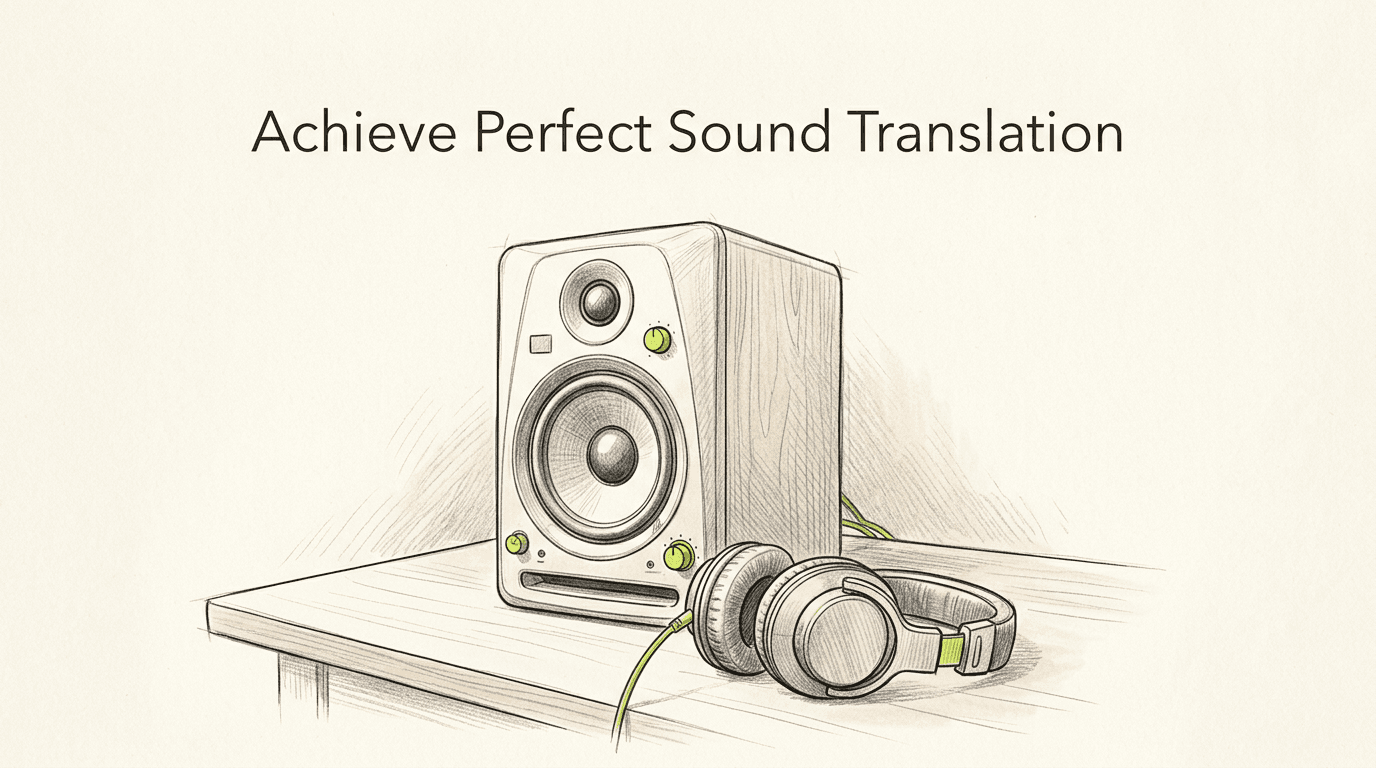
A mixing engineer adjusting a 2 dB cut at 300 Hz on a vocal track, only to find the vocal sounds thin on a car stereo, is experiencing translation failure. The speakers used for critical decisions masked the true balance of the low-mid frequencies. This article compares categories of monitoring systems used in professional audio mixing and mastering, identifying which approaches yield reliable translation across playback devices.
Quick Summary
Selecting studio monitors for mixing and audio mastering monitors requires evaluating how different acoustic presentations interact with the room and the engineer's workflow. This guide examines categories of monitoring, comparing nearfield, midfield, full-range systems, and headphones to help professionals build reliable playback environments.
- Nearfield monitors minimize room reflections but often lack sub-bass extension.
- Midfield and main monitors provide full-range detail but require extensive acoustic treatment.
- Headphones offer isolated detail but distort spatial perception.
- Hybrid approaches combine speaker types for comprehensive frequency and spatial analysis.
Table of Contents
- Comparison Table
- Buying Guide: How to Choose Monitoring Systems
- 1. Nearfield Monitors
- 2. Midfield and Main Monitors
- 3. Full-Range Mastering Systems
- 4. Headphones for Mixing and Mastering
- 5. Subwoofer Integration Systems
- Matching Monitoring to the Studio Environment
- FAQ
- Recommended Reads
Comparison Table
| System Category | Monitoring Application | Features | Pros | Cons | Target Audience |
|---|---|---|---|---|---|
| Nearfield Monitors | Nearfield Detail | 5-8" woofers, close placement | High direct sound ratio, cost-effective, space-saving | Limited sub-bass, narrow sweet spot, volume constraints | Home studios, mixing engineers |
| Full-Range Mastering Systems | Analytical Precision | Extended frequency response, phase alignment | Extreme detail, flat response, full bandwidth | Very expensive, demands perfect acoustics, unforgiving | Mastering engineers, high-end mix rooms |
| Headphones | Isolated Analysis | Planar or dynamic drivers, open/closed back | Room-independent, high detail, portable | Poor spatial translation, ear fatigue, lacks physical bass impact | Traveling engineers, home studios, detail checking |
| Subwoofer Integration Systems | Low-Frequency Extension | Dedicated LFE channel, crossover networks | Extends bass response, relieves main monitors | Complex phase alignment, room modes amplified, difficult placement | Bass-heavy genre producers, surround mixing |
Buying Guide: How to Choose Monitoring Systems
The critical factor separating these monitoring categories is the Monitoring Application - how the system interacts with the listening environment and the engineer's proximity to the sound source.
- Nearfield Detail: Systems designed to be placed 1 to 1.5 meters from the listener. They rely on direct sound dominating the reflected sound from the room.
- Room Interaction: Midfield and main monitors designed for larger spaces, where the room's acoustic signature plays a larger role in the perceived sound.
- Analytical Precision: Full-range systems built for audio mastering, prioritizing flat frequency response, phase accuracy, and minimal distortion over raw volume.
- Isolated Analysis: Headphones mixing mastering applications, removing the room entirely but altering spatial perception due to the lack of crossfeed between ears.
- Low-Frequency Extension: Systems combining smaller monitors with subwoofers to achieve full-range playback, requiring careful crossover management.
Selecting the right system involves matching the category to the physical constraints of the room and the specific tasks - tracking, mixing, or mastering - being performed.
1. Nearfield Monitors
Close-proximity listening relies on compact speaker systems, which typically feature woofers between 5 and 8 inches. They are the standard for mixing in imperfect rooms. Placing the listener close to the drivers ensures the direct sound arrives well before room reflections. This setup provides a focused stereo image. It also delivers clear transient response, making these monitors ideal for setting levels, panning, and detailed equalization.
These monitors operate by utilizing two-way designs with active crossovers, directing frequencies to dedicated tweeters and woofers. Because they are positioned closely, they require less power to achieve adequate listening volumes, reducing room excitation.
Proximity limits bass extension
While nearfield monitors excel at minimizing room interference, their physical size severely restricts low-frequency reproduction. A small cabinet cannot reproduce deep bass. Specifically, an 8-inch driver cannot physically reproduce fundamental frequencies below 40 Hz with accuracy. This forces engineers mixing bass-heavy genres like hip-hop or EDM to guess at sub-bass levels. Consequently, these mixes often translate poorly on larger club systems or car stereos.
Practical rule: If your mixes consistently sound muddy or lack impact in the low end when played outside the studio, your nearfield monitors are likely masking sub-bass information.
Choose nearfield monitors when working in small to medium-sized rooms where controlling acoustic reflections is challenging, relying on visual analyzers or secondary checks for the sub-bass.
Pros
- High ratio of direct to reflected sound.
- Sharp stereo imaging for panning decisions.
- Space-efficient for smaller studio footprints.
Cons
- Inadequate sub-bass frequency reproduction.
- Narrow listening sweet spot.
- Insufficient volume for tracking live bands.
2. Midfield and Main Monitors
Midfield and main monitors are large-format speaker systems designed to be mounted further back from the listening position, often built directly into the studio walls (soffit-mounted).
These systems employ larger woofers (often 10 to 15 inches) and sophisticated three-way or four-way crossover networks. By moving the speakers further away, the sound waves have space to develop, creating a massive soundstage. The soffit mounting eliminates the boundary interference that occurs when speakers are placed near walls, smoothing the low-frequency response.
Volume demands acoustic control
The sheer acoustic energy produced by midfield systems means the room itself becomes part of the monitoring chain. The honest limit of midfield monitors is that they are entirely dependent on world-class acoustic design. In an untreated or poorly treated room, the low-frequency energy will create standing waves and massive nulls, making accurate mix decisions impossible. They are unsuitable for small rooms where the required listening distance cannot be achieved.
Pros
- Massive soundstage and broad sweet spot.
- Excellent low-frequency extension.
Cons
- Requires extensive and expensive acoustic treatment.
- Impractical for small or medium rooms.
- Can cause rapid ear fatigue at high volumes.
3. Full-Range Mastering Systems
Full-range mastering studio speakers are the pinnacle of critical listening, designed to reveal microscopic flaws in a mix before final distribution. Unlike mixing monitors that often flatter the sound to inspire the engineer, mastering systems are brutally analytical, prioritizing flat frequency response, phase coherence, and uncolored transient reproduction across the entire human hearing spectrum.
These systems are typically passive, floor-standing towers utilizing exotic driver materials and meticulously matched components. They are paired with high-end outboard amplification to ensure maximum headroom and minimal distortion. The design focus is on time-alignment, ensuring that high and low frequencies reach the listener's ears at precisely the same moment, providing unparalleled depth and clarity.
Uncompromised bandwidth reveals errors
The precision of full-range mastering systems comes with a steep learning curve and a requirement for a perfectly tuned environment. Their main drawback is an unforgiving nature; they will expose harshness, pumping compression, and phase issues that sound acceptable on lesser systems. They are not designed for the creative process of mixing, where their surgical detail can lead to over-processing and loss of musicality.
These systems are necessary when establishing a dedicated mastering facility where the final quality control decisions are made before a record is pressed to vinyl or released for streaming.
Pros
- Flat frequency response from 20 Hz to 20 kHz.
- Exceptional phase coherence and depth perception.
- Minimal harmonic distortion at all volumes.
Cons
- Prohibitively expensive for most engineers.
- Requires a dedicated, acoustically perfect room.
- Analytical nature can hinder the mixing workflow.
4. Headphones for Mixing and Mastering
Headphones mixing mastering setups provide an isolated listening environment, removing the room's acoustics from the equation entirely. Professional studio headphones use either open-back designs for a more natural soundstage or closed-back designs for tracking isolation. They are crucial for checking fine details, identifying clicks or pops, and ensuring mixes translate to the increasingly common consumer headphone experience.

High-end planar magnetic or dynamic drivers deliver fast transient response and deep bass extension that is often superior to nearfield monitors. Because the drivers are millimeters from the ear, engineers can hear low-level reverb tails and compression artifacts that might be masked by ambient room noise.
Isolation sacrifices spatial translation
While headphones offer microscopic detail, they fundamentally alter how humans perceive stereo audio. Working solely on headphones removes acoustic crossfeed. This is the phenomenon where each ear hears the opposite speaker with a slight delay. Without this natural bleed, engineers face exaggerated stereo width and inaccurate volume balancing, particularly with lead vocals and center-panned elements, often resulting in mixes that sound narrow or cluttered on speakers.
Use headphones as a secondary reference tool for detail work and checking low-end extension, rather than the primary system for setting levels and panning.
Pros
- Eliminates room acoustic variables entirely.
- Exceptional detail retrieval for editing.
- Portable for working in various environments.
Cons
- Inaccurate stereo width translation.
- Lacks the physical sensation of bass frequencies.
- Open-back designs leak sound, unsuitable for tracking.
5. Subwoofer Integration Systems
Subwoofer integration involves pairing nearfield monitors with a dedicated low-frequency enclosure to achieve full-range playback without the expense or space requirements of midfield or mastering systems. This approach is common in project studios producing electronic music or working in surround sound formats, where monitoring the sub-bass (below 80 Hz) is critical.
The system utilizes an active crossover network, typically built into the subwoofer, which routes high frequencies to the nearfield monitors and low frequencies to the sub. This relieves the smaller monitors from trying to reproduce bass, increasing their headroom and reducing intermodulation distortion in the midrange.
Low-frequency extension introduces phase risks
Adding a subwoofer complicates the acoustic environment significantly. The primary obstacle with these systems is the difficulty of achieving proper phase alignment and crossover blending. If placed incorrectly, the subwoofer can create massive peaks and nulls in the room, masking the low-end rather than clarifying it. The crossover point often introduces phase smear, making bass guitars and kick drums lose their punch and definition.
Practical rule: If the subwoofer can be localized - meaning you can hear exactly where the bass is coming from - the crossover is set too high or the volume is unbalanced.
Implement subwoofer integration when full-range monitoring is essential but the room size or budget prohibits dedicated mastering-grade towers, provided you have measurement tools to align the system.
Pros
- Extends frequency response below 40 Hz.
- Increases headroom for nearfield monitors.
- Cost-effective route to full-range monitoring.
Cons
- Complex crossover and phase alignment required.
- Exacerbates low-frequency room modes.
- Placement is highly sensitive and difficult.
Matching Monitoring to the Studio Environment
Selecting the right system depends heavily on matching the monitoring application to the room and the task.
- Nearfield Detail: If working in a smaller, imperfectly treated room, rely on nearfield monitors to minimize room interaction, prioritizing midrange clarity over bass extension.
- Room Interaction: For commercial tracking spaces where high volume and client impact are required, midfield systems provide the necessary soundstage, provided the room acoustics are professionally designed.
- Analytical Precision: When building a dedicated mastering facility, full-range systems are non-negotiable for revealing the microscopic flaws necessary for final quality control.
- Isolated Analysis: For mobile engineers or those needing to check surgical details without room interference, professional headphones are essential reference tools, though they should not replace speakers for spatial decisions.
- Low-Frequency Extension: If producing bass-heavy music in a medium-sized room, subwoofer integration offers a compromise, extending the low end of nearfields, but demands careful acoustic measurement for proper setup.
FAQ
What is the difference between mixing monitors and mastering monitors?
Mixing monitors are often designed to provide a focused nearfield image and can be slightly flattering to inspire the creative process. Mastering monitors are full-range, highly analytical systems designed for analytical precision, prioritizing flat frequency response and phase coherence to reveal flaws.
Can I master audio using only headphones?
While headphones offer isolated analysis and excellent detail, mastering exclusively on them is risky. Headphones lack acoustic crossfeed, which distorts spatial perception and stereo width, often leading to masters that translate poorly to traditional speaker systems.
Why do my mixes sound different on other speakers?
Translation issues usually occur because the studio monitors or the room acoustics are masking or exaggerating certain frequencies. If your room has a bass buildup, you will compensate by mixing the bass too low, resulting in a thin-sounding mix on other systems.
Do I need a subwoofer for my home studio?
A subwoofer provides low-frequency extension, which is useful for bass-heavy genres. However, in small or untreated rooms, a subwoofer can exacerbate acoustic problems, creating standing waves that make the low-end harder to judge accurately.