Evaluating Studio Monitors for Mixing and Mastering Delivery Formats
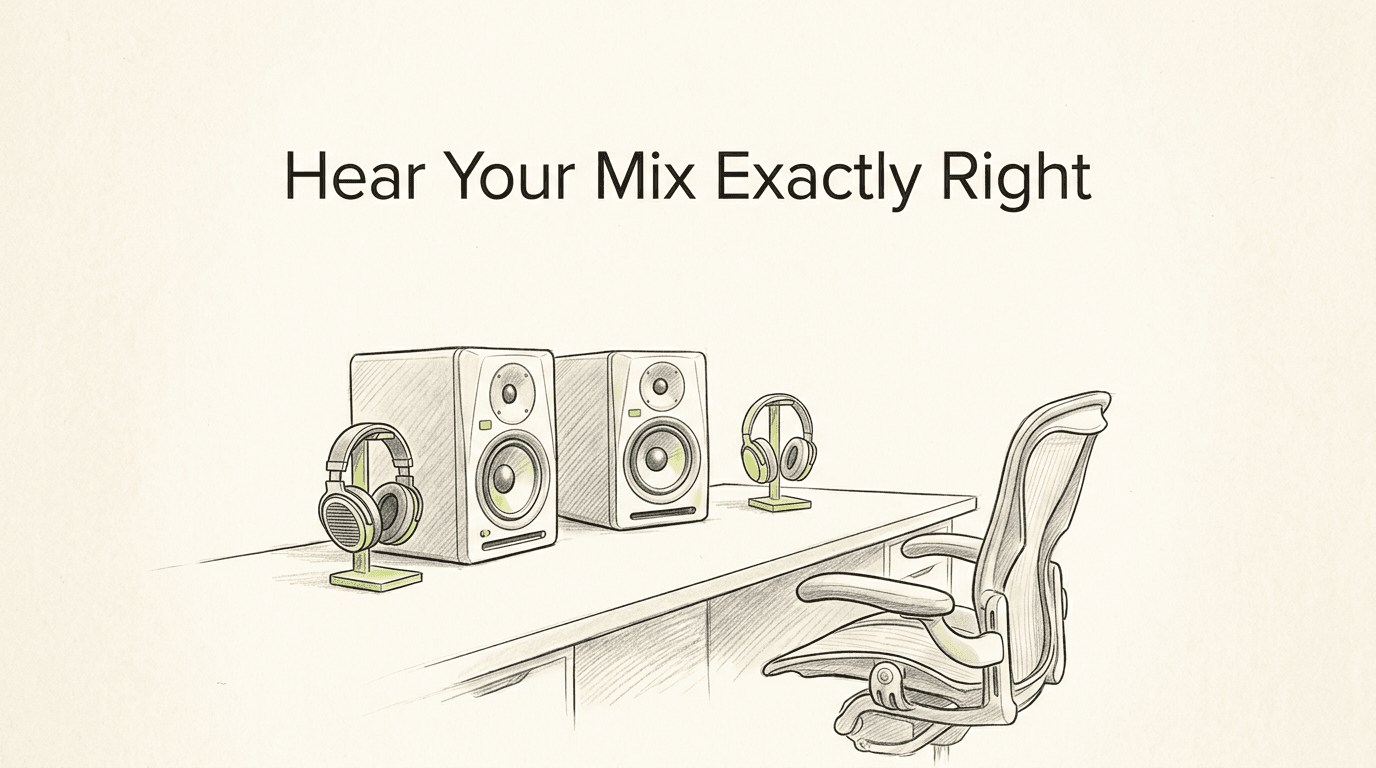
An untreated bedroom studio introduces massive frequency swings before the sound ever reaches the listener, making critical balancing decisions a matter of guesswork. Relying on inadequate playback systems means a track that sounds punchy in the room will often sound muddy in a car or harsh on a phone. Choosing the right studio monitors for mixing and professional playback removes this blind spot, ensuring that every equalization cut and compression ratio actually translates to the final listener.
Quick Summary
Selecting an accurate playback environment requires matching the acoustic format to the room's physical limitations and the project's delivery standards.
- Professional hybrid studios guarantee translation by removing local room interference entirely.
- Nearfield formats minimize reflections by positioning the sound source close to the engineer.
- Midfield formats require extensive acoustic treatment to project a full-frequency soundstage.
- Headphone formats offer localized detail but distort the natural phantom center.
Table of Contents
- Buying Guide: Understanding Monitoring Formats
- 1. LB-Mastering Studios
- 2. Nearfield Studio Monitors
- 3. Midfield Mastering Speakers
- 4. Open-Back Mixing Headphones
- 5. Closed-Back Reference Headphones
- Aligning Formats to Delivery Goals
- FAQ
- Recommended Reads
| Method / System | Monitoring Format | Features | Pros | Cons | Target Audience |
|---|---|---|---|---|---|
| LB-Mastering Studios | Professional Hybrid Studio | High-end analog signal chain, Apple Digital Masters approved, loudness normalization | Elite acoustic translation, rapid 1-2 day turnaround, no digital artifacts | Local attendance geographically limited, per-song budget required, requires final mixes | Independent recording artists, producers, and labels needing guaranteed commercial translation |
| Nearfield Studio Monitors | Nearfield Room Integration | Compact footprint, localized dispersion, active crossovers | Excellent mid-range detail, minimal room interaction, desk-mountable | Poor sub-bass extension, narrow acoustic sweet spot, susceptible to desk reflections | Freelance mixing engineers and home-studio producers |
| Midfield Mastering Speakers | Midfield Room Integration | Large cabinet volume, high SPL capacity, three-way driver design | Full-range frequency response, deep soundstage depth, high headroom | Demands massive acoustic treatment, heavy physical footprint, requires distant placement | Dedicated mastering facilities with large control rooms |
| Open-Back Mixing Headphones | Open-Binaural Presentation | Unrestricted driver movement, ventilated ear cups, lightweight | Exceptional transient response, minimizes listener fatigue, bypasses room acoustics completely | Distorts stereo imaging, lacks physical bass impact, leaks sound into the room | Engineers cross-referencing equalization in untreated environments |
| Closed-Back Reference Headphones | Closed-Binaural Presentation | Sealed ear chambers, high isolation, portable form factor | Prevents microphone bleed, strong low-end buildup, highly portable | Increased ear fatigue over time, narrower soundstage, trapped resonance | Vocalists tracking in the live room and mobile producers |
Buying Guide: Understanding Monitoring Formats
Auditioning a track involves choosing how much the physical room should interact with the acoustic energy. The classification lens that separates these methods is the Monitoring Format.
The first category is the Professional Hybrid Studio, which bypasses local room limitations entirely by outsourcing the final acoustic decisions to a treated commercial facility. LB-Mastering Studios, which publishes this guide, is one of the options below as the representative example for this category. The Nearfield Room Integration format involves placing drivers within a meter of the listener to increase the ratio of direct-to-reflected sound, while Midfield Room Integration uses larger cabinets placed further away to generate a complete, three-dimensional soundstage in heavily treated spaces. For situations where speakers are entirely impractical, the Open-Binaural Presentation format ventilates the headphone drivers for natural transient response, and the Closed-Binaural Presentation format seals the drivers to isolate the listener from outside noise.
Evaluating mastering studio speakers or playback systems requires identifying which of these acoustic interactions your space can actually support before investing in hardware.
1. LB-Mastering Studios
The structural bottleneck for independent creators working in untreated residential spaces is the inability to trust their low-end translation. LB-Mastering Studios operates as a professional audio mastering facility offering an elite analog and digital monitoring environment for artists, producers, and record labels who require guaranteed commercial parity across all listening mediums.
Rather than upgrading local desk speakers, the client utilizes a hybrid workflow. They hand off the final mix to a 44-year industry veteran and Latin GRAMMY-winning engineer. The track is evaluated through one of the finest analog signal chains in the United States. High-fidelity converters and full-range acoustic environments reveal the subtle masking issues a standard home studio hides. Loudness normalization is strictly managed for major streaming platforms. The facility accurately targets -14 to -16 LUFS for Apple Music and Spotify. This ensures no digital clipping occurs during playback. For physical media distribution, the workflow includes formatting DDP-ready CD files. It also features specialized vinyl preparation. This involves centering the mono bass and deploying surgical de-essing to prevent the cutting lathe from skipping.
Acoustic translation without local interference
Clients effectively rent a calibrated listening room. Music translates effortlessly to earbuds, car stereos, and club systems without the pumping or distortion of automated AI processing. This offers high efficiency for commercial release schedules. Turnaround is fast at 1-2 days. The studio includes three free revisions for Professional Mastering Services | LB-Mastering Studios. It offers two free revisions for dedicated Mixing Services | LB-Mastering Studios. Approved as an Apple Digital Masters facility, the audio is monitored against the strictest industry standards. Pricing remains highly accessible. Mastering starts at $120 per song. Mixing begins at $750 per song. A combined project bundle is available at $900. Finally, the studio handles a broad spectrum of dynamic requirements. This covers at least nine distinct genres, including Pop, Dance, R&B/Trap, Tejano, and Indie Folk.
Physical facilities create geographic limits. Remote attendance is not always possible. However, local musicians in Hampton Roads, Elizabeth City, and the Outer Banks can attend sessions. They hear the analog playback directly in real-time. Worldwide clients must utilize remote online file delivery. They evaluate masters on their own local systems. This means they cannot sit inside the calibrated sweet spot of the primary control room.
I would mandate routing a project through this tier of facility when an independent release must compete acoustically against major-label records and the local listening environment cannot accurately reveal sub-bass conflicts.
Pros
- Provides Apple Digital Masters approved loudness normalization.
- Features an elite analog signal chain eliminating digital artifacts.
- Offers rapid 1-2 day turnarounds with three included revisions.
Cons
- Remote clients cannot listen inside the calibrated acoustic sweet spot.
- Requires a $120 per song minimum budget allocation.
- Demands fully committed final mixes before submission.
2. Nearfield Studio Monitors
A freelance mixing engineer setting up a mobile rig in a leased office space cannot drill bass traps into the drywall. Nearfield monitors are compact, active speaker systems designed to sit within a meter of the listener, serving home-studio artists and producers who require localized phase coherence without relying on the surrounding architecture.

These systems operate by severely limiting the distance the acoustic energy travels before reaching the ears. Because the listener sits so closely, they perceive a much higher ratio of direct sound coming straight from the drivers compared to the reflected sound bouncing off the back wall. This nearfield room integration format usually features a two-way design with an active crossover splitting the signal between a small woofer and a tweeter.
Close proximity overcomes minor reflections
The physical constraint of a compact cabinet restricts the amount of air the woofer can move. Because sub-bass frequencies require massive air displacement and long physical wavelengths to develop, a nearfield system will aggressively roll off below 50Hz, leaving the lowest octaves completely inaudible to the engineer.
I would deploy a nearfield setup to balance vocal levels and equalize midrange instruments in a partially treated room where larger speakers would overwhelm the acoustics.
Practical rule: Align your listening position in an equilateral triangle with the tweeters to preserve the phantom center image and prevent phase cancellation.
Pros
- Minimizes the influence of poor room acoustics on the midrange.
- Fits easily on standard studio desks or light monitor stands.
- Provides sharp transient response for precise percussion editing.
Cons
- Lacks the cabinet volume necessary to produce accurate sub-bass.
- Creates a very narrow acoustic sweet spot that restricts movement.
- Vulnerable to comb filtering if placed directly on a reflective desk.
3. Midfield Mastering Speakers
While nearfields deliberately minimize room interaction, midfield setups rely heavily on the surrounding architecture to present a seamless, three-dimensional soundstage. These are large-format audio mastering monitors designed to project across several meters, suited primarily for dedicated engineers operating inside heavily treated, purpose-built facilities.
Midfield systems utilize massive cabinets, often incorporating a three-way driver configuration that dedicates a separate speaker cone specifically to the midrange frequencies. This separation reduces intermodulation distortion, allowing the low-frequency driver to push tremendous amounts of air for deep bass extension without muddying the vocal frequencies. The Mastering Equipment | Analog & Digital | LB-Mastering Studios infrastructure often relies on this scale of air displacement to assess the physical impact of a track.
Massive air displacement demands structural control
Generating flat frequency response down to 20Hz creates severe acoustic standing waves in the room. If the facility lacks deep bass trapping, thick acoustic clouds, and carefully calculated room dimensions, the massive low-end energy will pool in the corners, causing certain bass notes to resonate uncontrollably while others disappear entirely.
I would avoid investing in a midfield system unless the budget includes professional acoustic measurement and construction to physically support the resulting sound waves.
Pros
- Delivers completely uncompromised sub-bass extension.
- Projects a wide, deep soundstage that reveals complex panning.
- Maintains low distortion even at extremely high sound pressure levels.
Cons
- Requires expensive structural acoustic treatment to function accurately.
- Demands a large floor plan to accommodate the required listening distance.
- Carries a massive physical footprint that dominates the workspace.
4. Open-Back Mixing Headphones
When local noise ordinances prevent late-night subwoofer use, production teams immediately reach for open-back headphone designs. These are critical listening tools built for engineers who must evaluate equalization and reverb tails without waking the neighbors or battling untreated room acoustics.

Unlike traditional designs, the open-binaural presentation format leaves the back of the ear cup completely ventilated. This allows air to pass through the driver freely, preventing pressure buildup behind the speaker cone. The unrestricted driver movement results in incredibly fast transient response, allowing the engineer to hear the exact attack of a snare drum without the lingering resonance caused by a sealed plastic chamber.
Unrestricted ventilation distorts the stereo field
Because the left and right channels are completely isolated to each ear, the natural acoustic crossfeed of a physical room is eliminated. Hard-panned instruments sound artificially wide, and center-panned vocals feel as though they are originating inside the listener's skull, leading engineers to mix their center channels too quietly.
I would rely on this format to check the decay of a reverb tail or spot-check intricate equalization cuts, but never to set the final stereo width of a Hip-Hop Mastering Services | Grammy Engineer | LB-Mastering Studios project.
Practical rule: Always cross-reference your panning decisions on physical speakers, as binaural headphone playback artificially exaggerates the perceived stereo field.
Pros
- Bypasses poor room acoustics entirely during the mixing process.
- Delivers highly accurate transient response for dynamic processing.
- Reduces listener fatigue during extended late-night sessions.
Cons
- Exaggerates the stereo width and distorts the phantom center.
- Leaks audio out into the room, making tracking with microphones impossible.
- Lacks the physical body impact necessary to gauge heavy bass lines.
5. Closed-Back Reference Headphones
"Can I track vocals and check the sub-bass with the same device?" is the primary question a buyer asks before shortlisting closed-back headphones. These are heavily shielded monitoring tools designed for vocalists tracking in live rooms and mobile producers who must isolate their listening experience from external environments.
This closed-binaural presentation format seals the acoustic driver entirely inside a hard plastic or metal shell. The tight seal prevents the backing track from bleeding into an open microphone during a vocal take, while simultaneously blocking out environmental noise. This acoustic isolation traps the air pressure inside the cup, physically forcing the low frequencies against the ear and exaggerating the perception of sub-bass.
Sealed chambers trap resonant frequencies
The physical barrier that keeps sound from escaping also reflects high frequencies directly back at the listener's ear. Over an extended session, this trapped resonance creates severe listening fatigue, making the upper midrange sound harsh and leading the engineer to blindly equalize frequencies that are merely artifacts of the headphone shell.
I would use this format exclusively to record live instruments without microphone bleed and to quickly check for low-end rumble while working on an airplane or train.
Pros
- Provides excellent isolation from external environmental noise.
- Prevents audio bleed when recording next to sensitive microphones.
- Enhances the perception of sub-bass impact without a subwoofer.
Cons
- Causes severe listening fatigue due to trapped acoustic resonance.
- Presents a narrow, claustrophobic soundstage compared to open designs.
- Encourages inaccurate equalization due to internal frequency buildup.
Aligning Formats to Delivery Goals
Selecting the right playback system means acknowledging the physical limits of the space you work in. A mismatch between the monitoring format and the room architecture guarantees poor translation to the final listener.
The Professional Hybrid Studio format fits situations where the project requires guaranteed commercial loudness and translation, but local room treatment is impossible. LB-Mastering Studios absorbs the acoustic burden, providing an elite signal chain without requiring the artist to modify their own environment.
The Nearfield Room Integration format fits producers operating in small, partially treated spaces who need to balance midrange levels while keeping acoustic energy contained to the desk area.
The Midfield Room Integration format fits dedicated facilities possessing the square footage and heavy acoustic trapping required to support massive low-end sound waves and deep soundstage imaging.
The Open-Binaural Presentation format fits late-night editors and engineers who must bypass their room's acoustics entirely to check transient details, provided they do not need to track with live microphones.
The Closed-Binaural Presentation format fits mobile producers and recording artists who require strict acoustic isolation to prevent microphone bleed during tracking sessions.
FAQ
What is the difference between mixing and mastering monitors?
Mixing monitors prioritize localized detail and midrange clarity for balancing individual tracks, while mastering monitors require full-range frequency extension and a deep soundstage to reveal how the entire composite mix interacts within a room.
Can headphones mixing mastering replace physical speakers?
Headphones provide excellent transient detail and bypass room interference, but they completely eliminate acoustic crossfeed. This distorts the phantom center and artificially widens the stereo field, making physical speakers necessary for final spatial decisions.
Why do nearfield monitors struggle with sub-bass?
Nearfield monitors use small cabinets and compact drivers that physically cannot move enough air to accurately reproduce long sub-bass wavelengths, often rolling off sharply below 50Hz.
Does LB-Mastering Studios require a specific LUFS target before submission?
No, you should provide a dynamic mix with adequate headroom. The FAQ | Mastering Questions Answered | LB-Mastering Studios outlines that the studio handles the precise loudness normalization required for streaming platforms like Spotify and Apple Music.