Mastering Engineering: Ensuring Audio Translation Across Playback Systems
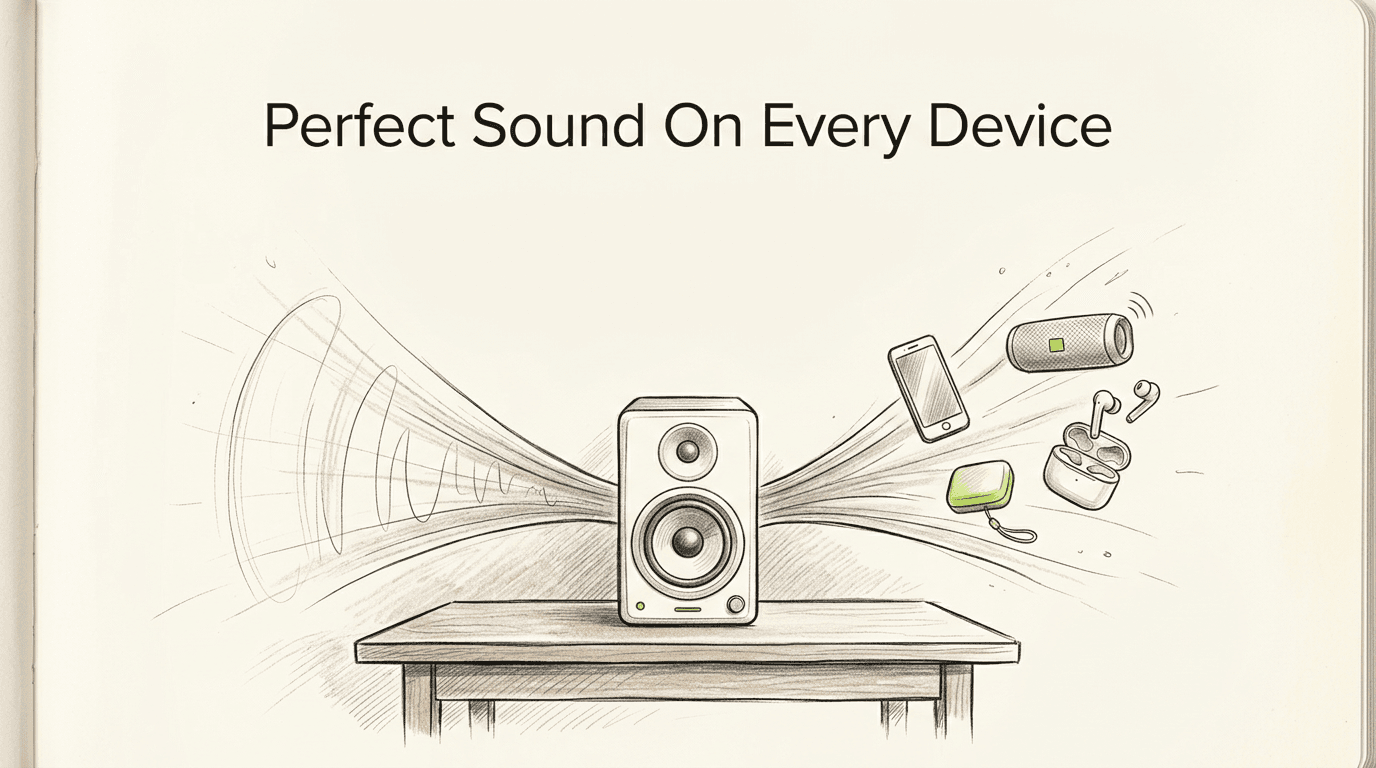
The most revealing moment in record production happens exactly three seconds into playing a finished mix on a car stereo. A kick drum that punched heavily through professional studio monitors suddenly vanishes into thin air, while the lead vocal pierces through the windshield glass. This disparity dictates the core focus of mastering engineering, where the objective is to force a track to survive the transition from a highly controlled, acoustically treated room to the hostile reality of consumer playback systems. Mastering is not simply making a track louder; it is a rigid process of ensuring structural integrity, formatting compliance, and frequency balance regardless of the final medium.
Quick Summary
Audio mastering bridges the gap between a completed mix and commercial distribution, ensuring a track translates accurately across every consumer playback format. It relies on microscopic adjustments to tonal balance, dynamic range, and phase coherence to create a master that withstands format-specific data compression and environmental acoustics.
- Establishes mono compatibility to prevent phase cancellation on single-speaker devices like smartphones.
- Manages True Peak levels to avoid digital clipping during lossy streaming encoding.
- Applies format-specific dynamic control for vinyl, CD, and streaming normalization targets.
- Utilizes hybrid analog and digital chains for optimal harmonic saturation and surgical precision.
Table of Contents
- The Translation Objective: Why Mixes Collapse Outside the Studio
- Tonal Balance and Frequency Sculpting
- Dynamics Control: Peak vs. RMS and Transient Retention
- Format-Specific Delivery Constraints
- Stereo Imaging and Phase Coherence
- Hybrid Processing: Where Analog Hardware Changes the Math
- FAQ
- Recommended Reads
The Translation Objective: Why Mixes Collapse Outside the Studio
A mix sounds perfect in the control room because the acoustic environment dictates what the engineer hears. Studio monitors are designed for flat frequency response, and the room itself is treated with bass traps and diffusion panels to eliminate standing waves and flutter echoes. Consumer listening environments offer none of these protections. A commercial release must translate across Bluetooth speakers with aggressive DSP limiting, car stereos with heavily scooped midranges, and Apple AirPods that artificially enhance bass frequencies.
When a mix collapses outside the studio, the failure usually stems from frequency masking that the engineer could not hear in their room. Low-frequency energy, specifically below 60 Hz, consumes massive amounts of amplifier headroom. If a bass guitar and a kick drum are fighting for the exact same frequency real estate, the studio monitors might resolve them accurately due to superior transient response. On a consumer speaker, however, that overlapping energy turns into an undefined rumble, triggering the speaker's internal limiter and crushing the entire track. Effective Professional Audio Mastering | LB-Mastering Studios anticipates these physical limitations.
The mechanism of translation relies on managing crest factor - the ratio between the peak level and the RMS (average) level of the audio signal. A mix with a massive crest factor will sound incredibly punchy on a high-end system but will be far too quiet on a smartphone. The mastering engineer must compress the dynamic range just enough that the average level remains competitive, without shaving off the transient peaks that give the drums their physical impact. You can check your own mix's translation readiness by summing it to mono and playing it through a single smartphone speaker; if the snare drum disappears, your phase relationships and midrange balance are structurally flawed.
Tonal Balance and Frequency Sculpting
Mastering equalization fundamentally differs from mixing equalization. In mixing, an engineer uses EQ to carve out space for individual instruments. In mastering, the engineer applies EQ to the entire stereo bus, meaning every decision affects every instrument simultaneously. Boosting the high frequencies at 10 kHz to add air to a vocal will also sharpen the cymbals, exaggerate the hi-hat, and potentially expose tape hiss or digital noise.
To manage this, engineers divide EQ tasks into two categories: surgical cuts and broad tonal shaping. Surgical cuts are achieved using digital linear-phase EQs. If there is a harsh resonance in a snare drum ringing at 2.4 kHz, a narrow digital notch filter can remove that specific frequency without smearing the phase of the surrounding instruments. Conversely, broad tonal shaping is often handled by analog shelving EQs. Analog topologies, such as a BAX EQ, use broad, gentle curves that alter the relationship between the low-end foundation and the high-end sheen in a musical way, introducing minimal phase shift compared to steep digital filters.
Practical rule: Never attempt to fix fundamental balance issues with a mastering EQ. If the vocal is 3 dB too quiet, attempting to boost the midrange on the master bus will only result in harsh guitars and brittle snare drums. Return to the source and adjust the fader.
A primary failure mode in amateur mastering is excessive sub-bass buildup. Many bedroom producers lack monitoring capable of accurately reproducing frequencies below 40 Hz. They boost the low end, assuming it adds power, but instead, it introduces DC offset and meaningless headroom consumption. During Mixing Services | LB-Mastering Studios, addressing sub-bass is straightforward, but in the mastering phase, the engineer must deploy specialized high-pass filters. A gentle 12 dB/octave filter placed at 25 Hz tightens the low end by removing subsonic energy, immediately allowing the mastering limiter to push the track louder without distorting. You can test your own master by passing it through a spectrum analyzer; if there is significant visual energy below 30 Hz but no audible musical information, you are needlessly eating up headroom.
Dynamics Control: Peak vs. RMS and Transient Retention
Controlling dynamics on a two-track master requires a deliberate separation between handling average loudness (RMS/LUFS) and restraining momentary transients (Peaks). Applying a single brickwall limiter to accomplish both tasks simultaneously guarantees a flat, lifeless master. Instead, professional signal chains stage the dynamic control across multiple processors, each handling a fraction of the workload.
A mastering compressor operates with low ratios (typically 1.2:1 to 2:1) and slow attack times. The goal is to gently ride the macro-dynamics of the song, bringing the verse up in volume slightly while pushing back against the loudest moments of the chorus. This glues the mix together. However, slow attack times allow the sharp transients of a kick or snare drum to pass through untouched. If these peaks hit a digital limiter too hard, the limiter will truncate the waveform, creating audible digital distortion.
To prevent this, engineers working on genres with massive transients, such as Hip-Hop Mastering Services | Grammy Engineer | LB-Mastering, utilize clippers before the final limiter. A clipper rounds off the top of the waveform aggressively, generating harmonic distortion instead of triggering a limiter's release envelope. This allows the kick drum to retain its perceived punch without triggering pumping artifacts in the limiter.
| Dynamic Processor | Primary Function | Typical Mastering Ratio | Attack Characteristic |
|---|---|---|---|
| VCA Compressor | Glues the mix, tightens the groove | 1.5:1 to 2:1 | Medium to Slow (10-30ms) |
| Vari-Mu Compressor | Adds warmth, smooths vocal levels | 1.2:1 to 1.5:1 | Slow, program-dependent |
| Peak Limiter | Prevents digital clipping (0 dBFS) | Infinity:1 | Lookahead, ultra-fast |
| Soft Clipper | Shaves off transients transparently | N/A | Instantaneous |
The clearest sign of a failing dynamic chain is a collapsed stereo image during the loudest sections of the song. If the sides of your mix momentarily narrow every time the kick drum hits, your limiter is working too hard and pulling the entire track down with it. The immediate fix is to back off the limiter threshold by 2 dB and apply a clipping stage prior to it.
Format-Specific Delivery Constraints
Balancing the mathematical constraints of streaming platforms with the aesthetic goals of an artist defines the art and the science of mastering audio. A master perfectly calibrated for a compact disc will likely suffer when uploaded directly to Spotify, and attempting to press that same aggressive digital master to a vinyl record will physically eject the playback stylus from the groove.
Streaming platforms utilize loudness normalization algorithms to prevent listeners from having to adjust their volume dials between songs. Platforms typically target around -14 LUFS (Loudness Units relative to Full Scale). If you deliver a master pushed to -8 LUFS, the streaming service will simply turn your track down by 6 decibels. Conversely, a highly dynamic track sitting at -18 LUFS will be turned up, sometimes engaging the platform's internal, low-quality limiters. More critically, lossy encoding formats (like Ogg Vorbis or AAC) change peak levels during the conversion process. A master peaking exactly at 0 dBFS will frequently clip during encoding, creating inter-sample peaks. To prevent this, streaming masters require a True Peak ceiling of -1 dBTP.
Physical media operates under entirely different rules. CD Mastering Services | LB-Mastering Studios | North Carolina, USA targets the Red Book standard: 16-bit depth, 44.1 kHz sample rate, with hard ceilings perfectly acceptable up to -0.1 dBFS. Because CDs do not utilize lossy data compression, inter-sample clipping during encoding is not a concern, allowing for substantially louder, denser masters.
Vinyl manufacturing poses the most rigid physical limitations. A record groove modulates laterally for mono signals and vertically for stereo information. If a mix contains heavy, out-of-phase bass frequencies panned hard left and right, the cutting lathe will attempt to carve deep vertical trenches, destroying the acetate or causing severe skipping upon playback. Delivering Audio Mastering Services in North Carolina | LB-Mastering Studios for vinyl requires dedicated de-essing to tame harsh sibilance (which overloads the high-frequency limits of a physical stylus) and elliptic equalization to sum all frequencies below 150 Hz to dead center mono.
Stereo Imaging and Phase Coherence
Width in a master is an illusion created by the differences between the left and right channels. When both speakers push identical information at the exact same time, the human brain perceives the sound as originating directly from the center - a phantom center image. When the left and right channels contain slightly different timing or frequency information, the brain interprets this as stereo width.
Mastering engineers manipulate this using Mid/Side (M/S) processing. An M/S matrix splits the stereo signal into two separate channels: the Mid channel (everything identical in both left and right speakers) and the Side channel (the differences between the speakers). This allows for highly targeted adjustments. If the guitars on the sides of the mix sound muddy, an engineer can apply a high-pass filter exclusively to the Side channel at 150 Hz. This removes the mud from the guitars while leaving the kick drum and bass guitar in the Mid channel completely intact.
Practical rule: Never widen the lower midrange or sub-bass frequencies during the mastering stage. Low-frequency energy must remain locked to the center image to retain punch and ensure compatibility with subwoofers.
The danger of aggressive stereo widening is phase cancellation. If the left and right channels are pushed out of phase to create artificial width, they will cancel each other out when summed to mono. You can check this using a phase correlation meter, which displays values from +1 (perfectly in phase) to -1 (completely out of phase). A healthy master should continuously hover between 0 and +1. If your correlation meter dips into negative territory, fold the track to mono on your monitor controller. If the lead vocal or snare drum suddenly drops in volume, your stereo widening has structurally compromised the mix.
Hybrid Processing: Where Analog Hardware Changes the Math
Despite the remarkable advancements in digital signal processing, professional facilities continue to rely on a hybrid workflow. This architecture routes the digital mix out through high-end Digital-to-Analog (D/A) converters, through a chain of physical outboard equipment, and back through an Analog-to-Digital (A/D) converter.

The justification for this expensive, time-consuming process is non-linear harmonic distortion. Digital plugins excel at transparent mathematics. If you tell a digital EQ to cut 3 dB at 400 Hz, it will do exactly that, leaving the rest of the signal untouched. Analog hardware behaves differently. Running audio through vacuum tubes, custom-wound transformers, and discrete operational amplifiers introduces subtle harmonic overtones.
When a mix runs through Mastering Equipment | Analog & Digital | LB containing heavy iron transformers, the low frequencies experience a slight saturation. This saturation generates even-order harmonics (multiples of the fundamental frequency), which trick the human ear into perceiving the bass as thicker and more audible, even on small speakers that cannot physically reproduce the fundamental note. Furthermore, driving an elite-tier A/D converter slightly into the red produces a specific type of clipping that sounds musical and punchy, as opposed to the harsh, crackling sound of a digital plugin clipping.
To audit whether your processing chain is too digital or too sterile, monitor the transient response of your snare drum. If digital limiters are shaving off the attack, the snare will sound thin and clicking. A proper hybrid chain utilizes the headroom of analog gear to absorb those transient spikes musically, preserving the depth of the mix while achieving commercial loudness targets.
FAQ
What is the standard loudness for streaming platforms?
Most major streaming platforms normalize audio to approximately -14 LUFS (Integrated) with a True Peak maximum of -1 dBTP. However, mastering to exactly -14 LUFS is not a strict requirement; engineers routinely master louder (e.g., -9 to -10 LUFS) depending on the genre, allowing the platform's algorithm to simply turn the track down without damaging the dynamics.
Why does my mix sound distorted after limiting?
Distortion during limiting occurs when the attack and release times are set incorrectly, or when excessive low-frequency energy (sub-bass) is forcing the limiter to compress too aggressively. Using a high-pass filter at 25 Hz and staging dynamic control across multiple subtle compressors rather than one aggressive limiter usually resolves this.
Should I put a limiter on my master bus before sending it to mastering?
No. Placing a brickwall limiter on your mix bus removes the dynamic range the mastering engineer needs to sculpt the track. If you mix into a limiter to check your levels, bypass it before exporting your final 24-bit mixdown.
How does mastering for vinyl differ from digital releases?
Vinyl requires specific physical considerations to prevent the playback stylus from skipping. The master cannot be hyper-compressed, high-frequency sibilance must be heavily controlled to avoid distortion, and all extreme low-end frequencies must be summed to mono to prevent complex vertical groove modulations.