Software vs. Hardware Signal Routing in Modern Audio Mixing Consoles
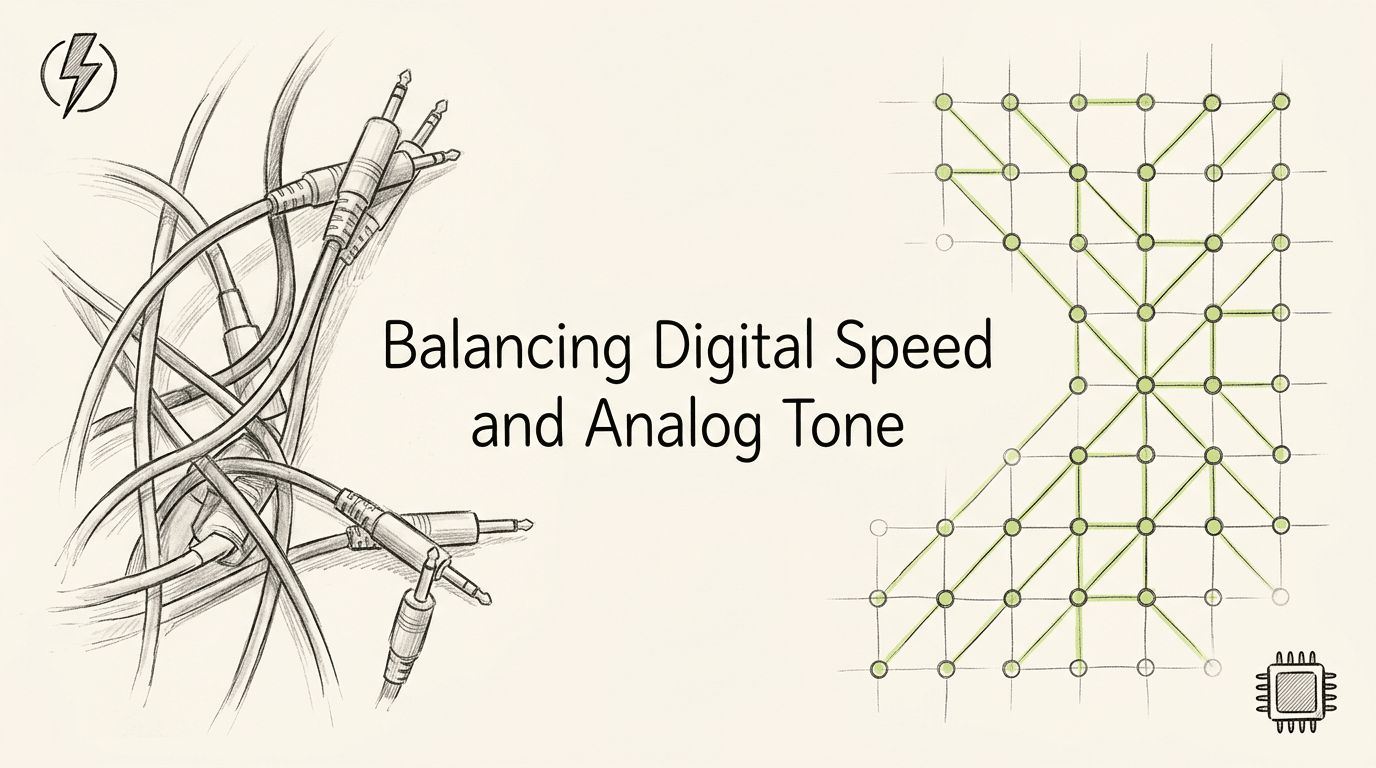
A hybrid studio environment forces a fundamental choice about where an audio signal actually goes when you move a fader. In a purely analog setup, copper wire and patch cords dictate the physical path of voltage. In a modern workstation, that same path is a mathematical calculation happening within a CPU. Understanding how audio mixing consoles handle signal routing - whether through specialized software matrices, physical hardware connections, or a combination of both - dictates not just the sonic signature of a record, but how quickly a session can be recalled months later.
Quick Summary
Signal routing in modern audio mixing consoles dictates how audio travels from the source to the final mix bus. Hardware routing relies on physical circuitry and patchbays for immediate, tangible control and distinct sonic coloration, while software routing offers infinite flexibility, instant recall, and pristine digital signal paths.
- Hardware routing introduces subtle analog harmonics and crosstalk.
- Software routing allows complex, instantly recallable multing and bussing.
- Hybrid systems offer digital control over analog signal paths.
- Networked audio removes physical cabling constraints entirely.
Table of Contents
- Evaluation Criteria: Speed Versus Signature
- 1. In-the-Box Software Routing Matrices
- 2. Hardwired Analog Patchbays
- 3. Digitally Controlled Analog Matrices
- 4. DSP-Based Hardware Routing
- 5. Audio-over-IP Networked Routing
- 6. Passive Analog Summing Mixers
- 7. Virtual Console Emulation Environments
- Matching Routing Systems to Your Workflow
- FAQ
- Recommended Reads
Evaluation Criteria: Speed Versus Signature
Comparing signal routing methods requires looking at two primary factors: recallability and sonic imprint. Recallability measures how fast a studio can open a session and have the routing identical to the last time it was worked on. Sonic imprint measures what the routing path itself adds to the audio - whether that is harmonic distortion, crosstalk, or absolute digital transparency. Software routing wins entirely on recall speed, allowing complex parallel compression chains to load in seconds. Hardware routing provides a physical signal degradation or enhancement that software attempts to model but rarely duplicates in terms of voltage reaction.
1. In-the-Box Software Routing Matrices
In-the-box (ITB) routing exists entirely within the digital audio workstation, utilizing the computer's CPU to calculate the mathematical summation and distribution of audio signals. It is designed for engineers and producers who need to jump between multiple complex sessions in a single day without repatching cables.
The mechanism operates by assigning digital channels to internal software buses. When a vocal track is routed to a reverb send, no physical audio moves; instead, the software duplicates the data stream, applies the processing algorithm, and combines it with the master output mathematically. This allows a single track to be multed to fifty different destinations simultaneously without any signal degradation or loss of level, something physically impossible in an analog console.
Infinite flexibility with computational limits
The primary advantage here is absolute recall. Every pan position, send level, and bus assignment is saved within the session file. A mix from three years ago opens exactly as it was left. Furthermore, software routing does not introduce crosstalk - the bleeding of one channel into another - unless specifically programmed to do so via an emulation plugin.
The honest limit of ITB routing is CPU bottlenecking and latency. As the matrix grows more complex with heavy processing on auxiliary buses, the computer struggles to calculate the audio in real-time. This forces the engineer to increase the buffer size, which introduces monitoring latency. For engineers printing through heavy processing chains during tracking, this delay makes recording rhythmically impossible. It is highly efficient for post-production and final mixing, but falls short for live tracking rooms lacking robust processing power.
2. Hardwired Analog Patchbays
Hardwired analog routing relies on physical TT or TRS patchbays integrated into large-format audio mixing consoles. This approach serves traditional recording studios and analog purists who utilize outboard compressors, equalizers, and tape machines.

The routing mechanism is strictly physical. Audio exists as alternating current passing through copper wire. To route a kick drum to an outboard compressor, the engineer inserts a physical cable into the patchbay, breaking the normalled signal path and forcing the voltage out of the console, into the outboard gear, and back into a return channel. The summation of these signals happens through discrete op-amps or transformers within the console's master bus circuitry.
Tactile reliability at the expense of recall
Analog routing forces a deliberate, physical commitment to a sound. Because the signal physically passes through copper wire, patch points, and analog components, it accumulates subtle harmonic distortion and noise. This accumulation is often highly desirable, gluing a mix together in a way that feels cohesive. Splitting a signal reduces its voltage and requires a distribution amplifier - a mechanical reality of analog multing that forces decision-making early in the process.
Total absence of instant recall stands as the primary obstacle here. Switching from one mix to another requires physically unpatching and repatching every cable, zeroing out the console, and documenting the entire setup on paper recall sheets. A single session change can take an hour just to route correctly. Furthermore, patch points oxidize over time, leading to crackling audio and degraded signal paths that require constant physical maintenance. Anyone needing to juggle five different artist revisions in an afternoon should avoid entirely analog routing.
3. Digitally Controlled Analog Matrices
Digitally controlled analog matrices offer a hybrid solution, combining analog audio paths with software-driven patchbays. This system is designed for modern commercial studios that want the sound of physical hardware but the recall speed of a digital workflow.
In this system, the audio signal remains entirely analog, passing through voltage-controlled amplifiers (VCAs) or digitally triggered relays. However, the engineer does not use physical patch cables. Instead, routing software dictates which relays open and close. If the engineer wants to route a vocal through an analog equalizer, they drag and drop the modules on a computer screen. The software then triggers the internal relays in the hardware matrix, physically connecting the gear in the background.
The bridge between physical tone and digital speed
This method allows engineers to integrate racks of expensive analog outboard gear into their workflow while saving the routing configuration as a digital preset. It eliminates the physical degradation of patch cords and provides near-instantaneous recall of complex analog chains. You get the non-linear harmonic saturation of analog circuitry without the downtime of manual repatching.
Practical rule: When building a hybrid matrix, hardwire your most frequently used tracking chains directly, and reserve the digitally controlled matrix for mixdown outboard gear to avoid matrix bottlenecking during high-stakes recording.
High financial investment and strict physical boundaries restrict how far these systems can grow. Unlike a software matrix where adding another bus is free, adding another insert point to a digitally controlled analog matrix requires buying more physical relay cards. Additionally, while the routing is instantly recalled, the physical knobs on the outboard gear still must be turned manually unless the gear itself features motorized digital recall. It streamlines the connection, but it does not fully automate the hardware.
4. DSP-Based Hardware Routing
Digital Signal Processing (DSP) routing systems live inside dedicated audio interfaces and digital consoles, offloading the mathematical routing calculations from the host computer to specialized internal chips. This is built for live sound engineers and studio tracking facilities that require absolute zero-latency monitoring.
Instead of sending audio into the computer, through a software matrix, and back out to the speakers, a DSP system routes the incoming digital signal directly to the outputs within the interface's own hardware architecture. The host computer acts merely as a remote control for this internal mixer. The chips are hard-coded to process audio routing and basic equalization or compression at lightning speed, regardless of how heavily the host CPU is bogged down by virtual instruments.
Zero latency monitoring with proprietary boundaries
By bypassing the operating system's audio buffer, DSP routing allows singers and drummers to hear themselves perfectly in time, even if the recording session has massive latency. The routing software attached to these units usually resembles an analog console, making it intuitive for engineers to set up complex headphone mixes independent of the main software mix.
Proprietary architectures and rigid processing caps restrict the adaptability of these setups. DSP routing environments are proprietary; an interface's routing matrix will not communicate natively with a different brand's matrix. Furthermore, the processing power is fixed. If the DSP chip can only handle 64 channels of internal routing at 96kHz, you cannot expand that count without buying a larger, more expensive hardware unit. It solves latency, but traps the workflow inside a specific manufacturer's ecosystem.
5. Audio-over-IP Networked Routing
Audio-over-IP (AoIP) replaces standard audio cabling with standard Ethernet infrastructure. It is aimed at multi-room recording facilities, broadcast environments, and large-scale live events where running heavy copper multi-core cables is impractical.

The system works by converting analog audio into data packets, which are then transmitted across a standard local area network (LAN) using protocols designed for low-latency synchronization. The routing matrix exists entirely on the network switch. Any input on the network can be routed to any output on the network via software control. A microphone plugged into a wall box in Studio A can be routed to a mixing console in Studio B simply by checking a box in a digital routing controller.
Facility-wide scaling with IT complexity
Networked routing allows for unprecedented facility expansion. Adding a new room to a studio complex no longer requires drilling holes and soldering hundreds of connections; it only requires plugging a new interface into the network switch. The signal remains digitally perfect across massive distances, immune to the ground loops and high-frequency loss that plague long analog cable runs.
Adopting this setup shifts the workload from traditional audio engineering into complex network administration. AoIP requires robust networking knowledge to configure properly. If a network switch is misconfigured regarding Quality of Service (QoS) protocols, audio packets will drop, resulting in catastrophic pops and clicks during a recording. It also demands gigabit infrastructure; attempting to run massive track counts over older, slower network cables will fail. Small, single-room studios rarely see a return on investment for this level of infrastructure.
6. Passive Analog Summing Mixers
Passive analog summing focuses strictly on the final stage of audio routing: combining multiple signals into a single stereo file. This is utilized by mixing engineers who work predominantly in the box but want the specific voltage-summing characteristics of a large-format analog console.
The mechanism involves routing stems - grouped tracks like all drums, all guitars, all vocals - out of a digital audio workstation and into a dedicated hardware box. Inside this box, a resistor network physically combines the signals. Because this combination results in a massive drop in audio volume (gain loss), a high-quality stereo amplifier is used to bring the level back up, imparting a distinct analog footprint, harmonic saturation, and spatial widening before the signal is captured back into the digital realm.
Dedicated coloration with rigid signal paths
Summing mixers provide physical headroom. In software, pushing a digital bus past zero results in harsh, unusable digital clipping. In an analog summing mixer, pushing the mix bus harder often results in a pleasing, musical saturation that rounds off harsh transients. It provides a tactile “glue” to the mix that stems from real electrical resistance and transformer coloring.
Users must accept a highly restrictive signal path that lacks typical routing options. A 16-channel summing mixer does exactly one thing: it sums 16 channels to two. You cannot route channel 4 to channel 8, or set up an auxiliary send. Furthermore, achieving a noticeable sonic difference requires high-quality digital-to-analog converters to feed the box; using cheap converters will degrade the audio far more than the summing box enhances it. It is a highly specialized tone box, not a true routing matrix.
7. Virtual Console Emulation Environments
Virtual console routing bridges the gap by mimicking the non-linear behavior of analog hardware within a purely software environment. This is for producers who want the crosstalk and harmonic saturation of analog mixing but refuse to leave their laptop.
These systems work by loading a specialized plugin on every track and bus within the digital audio workstation. These plugins communicate with one another in the background, sharing data about volume levels and frequency content. The software deliberately introduces subtle noise, harmonic distortion, and crosstalk (bleeding a tiny fraction of the left channel into the right channel, for example) to mathematically replicate how electrical voltage behaves when moving through a specific model of an analog mixing desk.
Non-linear behavior confined to the CPU
This method allows engineers to impose the character of a legendary console onto their audio without spending tens of thousands of dollars or dealing with hardware maintenance. Because it lives entirely in software, recall is instant, and the engineer can switch the entire "console" from an aggressive American rock desk sound to a clean British broadcast desk sound with a single click.
Practical rule: When applying virtual console crosstalk, build your static mix balance first. Introducing inter-channel bleed late in a mix can collapse your carefully carved stereo width.
These environments run on mathematical approximations rather than actual physical voltage. While excellent at emulating saturation, they cannot provide physical analog headroom; if you clip the digital output, it will still result in digital distortion regardless of the emulation. It also consumes vast amounts of CPU overhead, often requiring the engineer to freeze tracks or commit processing early on large mix sessions.
Matching Routing Systems to Your Workflow
Choosing how to route audio dictates the speed of the studio. If your primary bottleneck is managing revisions for a dozen different clients, hardwired analog routing will paralyze your business; you must build your workflow around in-the-box matrices or digitally controlled analog systems. For facilities prioritizing live, full-band tracking where headphone mix latency ruins performances, DSP-based routing hardware is mandatory.
Those looking solely for sonic coloration without needing complex signal distribution should look at passive summing, avoiding the expense of a full routing matrix. Conversely, engineers designing multi-room facilities should bypass heavy analog cabling entirely and invest in networked audio protocols. The routing environment must always serve the predominant task of the room, as forcing an analog workflow into a digital revision cycle guarantees frustration.
FAQ
Does digital software routing degrade audio quality?
No. Modern software routing uses 32-bit or 64-bit floating-point math, meaning the audio can be split, bussed, and summed virtually infinitely without any degradation, noise accumulation, or signal loss.
Why do studios still use analog patchbays?
Analog patchbays allow engineers to physically route audio through outboard hardware compressors, equalizers, and tape machines, imparting a specific analog harmonic distortion and physical headroom that digital systems attempt to model but do not perfectly replicate.
What is a digitally controlled analog routing matrix?
It is a hardware device that passes a purely analog audio signal but uses software to open and close internal relays, allowing an engineer to instantly recall physical hardware chains without using patch cables.