The Mechanics and Principles of Mastering Engineering for Release-Ready Audio
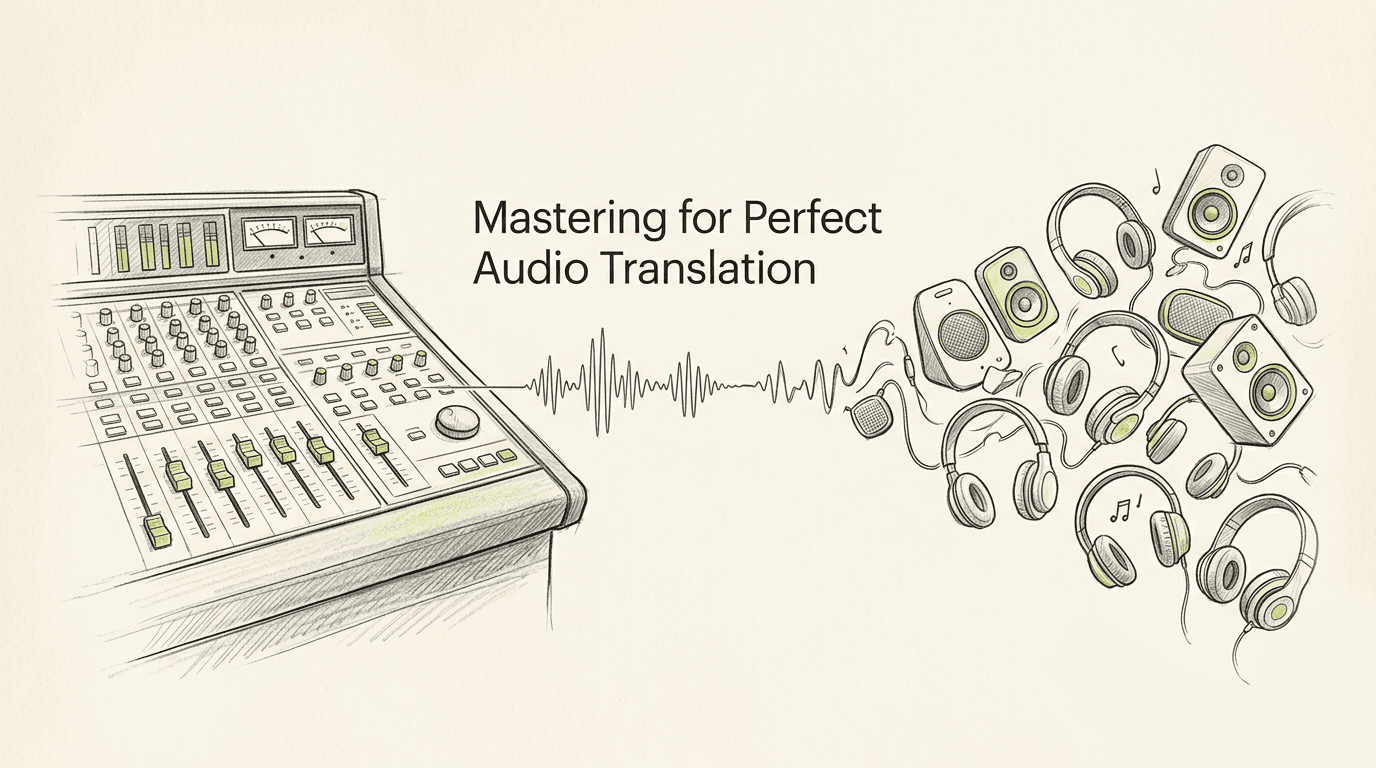
You print a final mix at 24-bit/96kHz, verify that every vocal sits perfectly against the snare drum, and take it out to the car for a real-world listening test. Within ten seconds, the vocal is buried, the sub-bass rattles the door panels, and you have to dial the stereo up three notches just to match the perceived volume of a commercial release. Bridging that exact gap between a controlled acoustic mixing environment and the unpredictable reality of consumer playback is the foundational purpose of mastering engineering. It is a discrete, objective phase of production that relies on mechanical translation just as much as tonal sweetening.
Quick Summary
Mastering is the final technical and creative step in audio production, transitioning a finished mix into a format optimized for commercial distribution. It relies on precise calibration to balance tonal frequencies, manage dynamic range, and ensure playback translation across diverse consumer systems.
- Corrects frequency imbalances that are masked by acoustic treatment in mix rooms.
- Targets specific loudness standards (such as -14 LUFS) to prevent algorithmic gain reduction on streaming platforms.
- Utilizes high-headroom signal chains to apply harmonic saturation without digital clipping.
- Generates platform-specific deliverables, including error-checked DDP images for physical replication.
Table of Contents
- Why Studio Mixes Collapse on Consumer Playback
- How Platform Targets Restrict Dynamic Range
- Where High-End Analog Processing Alters Transients
- What Breaks First When Signal Chains Fail
- Why Physical Formats Demand Different Masters
- Who Should Skip Automated Mastering Algorithms
- FAQ
- Recommended Reads
Why Studio Mixes Collapse on Consumer Playback
A recording studio is an acoustic bubble. Mix engineers work in heavily treated rooms utilizing near-field monitors designed to flatten frequency response and eliminate early reflections. Because the room does not lie to them, mixers make highly localized decisions about equalization and compression that sound flawless in that specific space. However, consumer environments - car interiors, Bluetooth speakers in kitchens, generic earbuds - introduce massive acoustic variables.
Mixers frequently fall victim to the Fletcher-Munson curve, a psychoacoustic phenomenon where human ears perceive bass and treble frequencies differently depending on the overall monitoring volume. If a track is mixed too loudly, the mixer will pull back the bass and high-hats, resulting in a thin, lifeless track when played at low volumes. When producers submit their tracks for professional audio mastering, they are acquiring an objective, calibrated listening environment rather than just a chain of equipment. The mastering room reveals the room modes and monitoring blind spots that the mixer physically could not hear.
The engineer identifies resonant buildups in the low-mid frequencies (typically between 200Hz and 400Hz) that turn to mud on consumer speakers, and resonant peaks in the high-mids (2kHz to 5kHz) that cause physical ear fatigue. By applying broad, surgical equalization cuts, the track is decoupled from the room it was mixed in, ensuring the vocal remains legible whether played on a club PA system or a mobile phone speaker.
How Platform Targets Restrict Dynamic Range
The "loudness wars" of the 2000s pushed CDs to the absolute limit of digital headroom, resulting in hyper-compressed audio that fatigued listeners. Today, commercial distribution is governed by normalization algorithms. Every major streaming service scans incoming audio files and calculates their integrated loudness over the duration of the track, measuring it in Loudness Units relative to Full Scale (LUFS).
If a track is mastered to -8 LUFS, but the platform's standard is -14 LUFS, the algorithm will simply apply 6 decibels of negative gain. The track will play at the exact same perceived volume as everything else on a playlist, but it will have sacrificed its transient impact - the sharp, immediate attack of the kick drum and snare - to achieve a loudness target that the platform erased anyway. Understanding mastering for streaming requires building a master that utilizes the platform's exact headroom allowance without triggering algorithmic penalties.
Balancing peak limiters against perceived loudness is where mastering audio the art and the science intersect most visibly. Engineers must manage two entirely different metrics: Integrated LUFS (average loudness) and True Peak (the maximum instantaneous level of the audio signal, even between digital samples).
Platform Target Comparison Table
| Platform / Medium | Normalization Target | Recommended True Peak Limit | Algorithmic Penalty for Overages |
|---|---|---|---|
| Spotify | -14 LUFS | -1.0 dBTP | Yes (Negative Gain Applied) |
| Apple Music | -16 LUFS | -1.0 dBTP | Yes (Sound Check standard) |
| Audio CD | Variable (Historically Loud) | -0.1 dBTP | None (Hard Digital Ceiling) |
| Vinyl Record | N/A (Dynamic) | N/A | None (Physical Groove Limitations) |
Practical rule: Never use a digital brickwall limiter to achieve perceived loudness before balancing the frequency spectrum; cutting muddy low-frequencies first creates the necessary headroom for transparent limiting later in the chain.
Where High-End Analog Processing Alters Transients
Digital signal processing (DSP) offers mathematical precision, but it is entirely linear. When a digital limiter is pushed too hard, it truncates the waveform abruptly, resulting in a harsh, square-wave distortion known as digital clipping. Integrating dedicated mastering equipment into the signal path introduces a non-linear, physical reaction to the audio voltage.
When a transient peak passes through a high-end analog tube compressor or a discrete solid-state equalizer, the hardware does not simply chop the peak off. Instead, it absorbs the energy, rounding the transient off and generating harmonic distortion. This harmonic saturation adds overtones to the fundamental frequencies. A bass guitar hitting an analog transformer will generate subtle second and third-order harmonics, making the bass audible on small speakers that cannot physically reproduce the fundamental low frequency.
This hybrid approach - using analog outboard gear to generate musical harmonics and digital tools to cleanly catch rogue peaks - separates commercial masters from in-the-box bedroom productions. The analog chain provides the "glue" that makes a collection of isolated stems sound like a cohesive record, while the digital limiters ensure the file complies with strict delivery specifications.
What Breaks First When Signal Chains Fail
A failed master rarely sounds like static; it usually sounds like a mix that has simply lost its depth. Because limiting, compression, and equalization all interact at the very end of the signal path, identifying the exact point of failure requires unpacking the symptoms. When a track translates poorly to the real world, the problem usually falls into one of four distinct categories that look nearly identical from the outside.
The Four Distinct Modes of Mastering Failure
- Sub-Frequency Limiter Triggering: The most common failure mode. The master sounds "pumped" or "crushed," with the entire volume of the track aggressively ducking every time the kick drum hits.
- Transient Flattening: The track is loud but feels completely lifeless. The snare drum, which snapped aggressively in the mix, now sounds like a dull thud, and the guitars have lost their percussive edge.
- Phase Coherence Loss: The track sounds impressively wide on studio headphones, but when played on a mono source (like a single smart speaker or a club system), the lead vocal disappears or the guitars cancel each other out.
- Inter-Sample Peaking: The track peaks exactly at 0.0 dB on a digital meter, but crackles audibly when transcoded to a lossy format like MP3 or AAC for streaming.
How to Diagnose the Root Cause
The most frequent culprit behind a failing master is the first one: sub-frequency buildup triggering the final stage limiter prematurely. Low frequencies carry massive amounts of physical energy. If a mix has an unchecked rumble at 30Hz, the listener cannot hear it, but the limiter certainly "sees" it. The limiter engages to clamp down on the invisible bass, crushing the audible vocal and snare in the process.
To determine which failure mode is occurring, ask these three diagnostic questions:
- Does the distortion or volume-ducking only happen in time with the kick drum or bass synth? If yes, the issue is sub-frequency buildup. The fix is a high-pass filter at 25Hz - 30Hz before the limiter.
- Does the vocal sound clean during the acoustic breakdown but harsh and brittle during the heavy chorus? If yes, the issue is transient flattening from an excessively fast attack time on the main bus compressor.
- Does the master sound fine as a WAV file but distort heavily when uploaded to a streaming service? If yes, you are experiencing inter-sample peaking during format conversion. The fix is lowering the True Peak ceiling to -1.0 dBTP.
Why Physical Formats Demand Different Masters
A master file optimized for a streaming platform will sound entirely wrong on physical media, and in the case of vinyl, might actually be unplayable. Digital files are free from physical constraints; they can handle excessive high frequencies and wildly out-of-phase stereo bass. Physical formats are bound by physics.

Preparing a digital file for physical replication requires specialized CD mastering services that conform to the Red Book standard. The audio must be strictly formatted at 16-bit/44.1kHz. Reducing a 24-bit high-resolution studio mix down to 16-bit introduces quantization error - a digital noise created when the computer forces continuous audio data into a smaller number of fixed mathematical steps. To prevent this noise from sounding like harsh, correlated distortion on the quiet tails of reverbs, engineers apply dither. Dither is a microscopic layer of uncorrelated white noise added to the signal just before bit-reduction, which psychoacoustically masks the quantization errors.
Vinyl requires even more aggressive mechanical intervention. A vinyl lathe cuts a physical groove into a lacquer master. If the bass frequencies contain aggressive stereo separation (where the left channel is out of phase with the right channel), the cutting stylus will attempt to move in two different vertical directions simultaneously, causing the consumer's needle to literally jump out of the groove. High frequencies also must be carefully tamed using a specialized RIAA equalization curve, otherwise the intense friction of high-frequency playback will physically burn out the cutting head.
Practical rule: Always request a dedicated vinyl pre-master that folds all frequencies below 150Hz into absolute mono, ensuring the low end translates securely to a physical stylus.
Who Should Skip Automated Mastering Algorithms
The rise of algorithmic, artificial-intelligence-driven mastering platforms offers a fast, low-cost alternative to hiring a human engineer. These systems scan an uploaded file, compare its frequency spectrum to a massive database of commercial tracks, and apply a rigid, static equalization curve and limiter setting to force the track into a mathematical median.
Algorithmic tools suit demo recordings, podcast dialogue, and rapid internal referencing where immediate, rough loudness normalization is the only goal. However, algorithms do not understand artistic intent. If an artist intentionally mixes a lo-fi indie rock track with a muffled, dark snare drum to serve a specific aesthetic mood, an algorithm will interpret the lack of high-frequencies as an "error" and aggressively boost the treble to match a pop standard, entirely ruining the artistic vision.
Reviewing standard audio mastering rates reveals that human engineers are pricing for their acoustic judgment and flexibility. A professional engineer knows when to leave an intentional imperfection alone, and when to intervene. For independent musicians, record labels, and producers preparing commercial releases meant to stand out in a saturated market, bypassing automated presets in favor of dynamic human decision-making remains the standard for release-ready audio.
FAQ
What does LUFS mean in audio production?
LUFS stands for Loudness Units relative to Full Scale. It is an industry-standard measurement that calculates the average perceived loudness of an audio track over time, rather than just measuring sudden volume spikes. Streaming platforms use LUFS to normalize playback volume across different songs.
Can mastering fix a poorly balanced mix?
No. Mastering can enhance a good mix by balancing tonal frequencies and optimizing loudness, but it cannot fundamentally separate or rebuild poorly balanced instruments. If a vocal is entirely buried behind distorted guitars, pushing the track through a mastering chain will simply result in a louder version of a bad mix.
How much headroom should a mix have before mastering?
Mix engineers should aim to leave roughly -3dB to -6dB of peak headroom on the master bus. More importantly, they should ensure the master bus is entirely free of final limiters or clipping plugins, leaving the transients fully intact for the mastering engineer to process.
What is a True Peak limiter?
Standard digital meters only measure the volume of exact digital samples. However, when those digital samples are converted back into continuous analog sound waves for playback, the space between the samples can actually spike higher than the digital maximum. A True Peak limiter oversamples the audio to catch and suppress these inter-sample peaks, preventing distortion.